Fullbench vs Q360
Both free to districts. Who actually competes for your openings, and whether the operator's own staffing affiliate plays by the same rules.
Compare · Swing Education
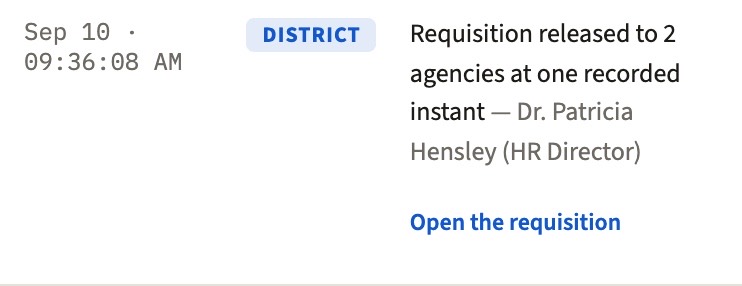
Fullbench™ is a Swing Education alternative for school districts that want every substitute and paraprofessional agency they use run as one program: each opening released to every approved agency at the same recorded instant, every file reviewed and approved by our team before a start date exists, and one invoice. The district pays no program fee.

Side by side
Swing Education supplies its own vetted substitutes. Fullbench runs every agency your district keeps, side by side, under one release, one clearance gate and one invoice. The differences are in who works each opening and who approves the file.
| Question | Fullbench | Swing Education (per its own published materials) |
|---|---|---|
| The model | A K-12 managed staffing provider (MSP) that runs every agency your district uses on the vendor management system it built for school staffing. | “The K-12 marketplace where every one of your absences is filled by a high-quality sub,” by its own description: a technology-driven substitute staffing platform with dedicated human support, used as a full service or as a supplement to a district’s own substitute pool. |
| Who works each opening | Every approved agency, every opening, released at the same recorded instant. The Fullbench team chases the submissions, the interviews and the no-shows. | Swing’s own vetted substitutes. Its matching prioritizes top-performing and nearby substitutes first and widens visibility in real time if a request is not filled. |
| Roles covered | Substitutes, paraprofessionals, special education, related services and nursing, from every agency you approve. | Day-to-day and long-term teachers, special education support including aides and 1:1s, bilingual and early childhood substitutes, paraprofessionals, clerical staff, and yard, lunch and bus monitors. |
| Who approves the file | Fullbench reviews, approves and tracks each required document for your district, and your office can pull any reviewed file at any time. The software cannot set a start date while anything is missing, unreviewed or expired, and a daily check warns you and the agency thirty days before a clearance lapses. | Swing “recruits locally, vets all substitutes, and continuously measures performance.” Its substitutes complete state requirements during Swing’s setup, for example fingerprint and TB clearance in California. |
| What the district pays | No program fee: no software fee, no per-seat fee, no implementation charge. Your office approves one rate range for each role, with no annual escalator. | Prices are not published on the pages reviewed. Swing describes custom school or district budgets, each request drawn from a chosen budget, with email alerts as spending approaches each budget’s limit. |
| Where it works | Your district, with the agencies you already use. You name them; we vet and onboard each one. | California, Texas, Arizona, New Jersey, Washington, DC, Illinois and New York, by its own list of states. |
| Invoice and record | One itemized invoice for every agency, each line traceable to a placement, a rate inside your approved range and hours a school approved. Every agency measured from the same release instant on one scorecard. | Spend tracked in real time against each budget in Swing’s dashboard. Integrates with Frontline Absence Management to sync absences. |
Based on publicly available information as of October 2026: Swing Education’s home page and FAQ, its budget page and its getting-started page with substitute requirements, listed with links below. “Not published” refers to those public materials, not to Swing’s contracts or internal practices; district terms vary. Swing Education is a trademark of its owner. Spot an error? Tell us and we will correct it.
The takeaway
Questions
Yes. Swing supplies its own vetted substitutes through a marketplace. Fullbench is a K-12 managed staffing provider that runs every agency your district keeps as one program: one release to every approved agency at the same recorded instant, every file reviewed and approved by our team before anyone starts, one invoice and no program fee.
Not on the pages we reviewed in October 2026; Swing describes budget tools rather than a price list. Fullbench charges the district no program fee: you pay one invoice for the hours your schools approved, at rates inside the range your office approved for each role, with no annual escalator.
Yes. You name the agencies you use; we approach each one, explain the terms and tell you who signed. Agencies keep their own people and brand, and their name stays on every submission. The program is exclusive for the roles it covers, so an agency that declines stops receiving the openings in the program.
No. Frontline, Red Rover or whatever your district uses keeps covering absences for your own employees. Fullbench runs the outside agencies that supply the people you do not employ: postings, clearances, time and one invoice across every agency.
Comparison last verified 19 October 2026 against Swing Education's own published materials.
Sources
Checked 19 October 2026. We compare only against what the other program publishes about itself — never against what a salesperson told us.
If anything here is out of date or wrong, tell us at hello@fullbench.co and we will correct it. Swing Education is a trademark of its owner; this page exists for factual comparison.
Other comparisons
Both free to districts. Who actually competes for your openings, and whether the operator's own staffing affiliate plays by the same rules.
An Amergis-scale, cross-sector MSP versus an education-only program with published economics.
Licensed VMS software your staff operate versus an operated program. Who runs the workflow, and what it costs the district.
One company's bench at a negotiated markup, or every agency you approve working inside one rate range your office approved.
A single-employer program at a negotiated markup, versus many agencies competing on one release log — and what each lets a district check afterwards.
Two education MSPs at no direct cost to the district. What differs: who sees each opening and when, who sets the rate, and who approves the file before day one.
VMS software from Amergis that a district's staff run, or a K-12 MSP that runs every agency for you on its own VMS.
Two education MSPs at no direct cost to the district. What differs: who curates the agencies, who sets the rate, and who approves the file.
Neither charges the district. What differs: an order of preference versus one release to every agency, and who approves the file.
VMS software licensed by staffing agencies and MSPs, or a program a district joins directly with no program fee.
Absence software for the people you employ, or a K-12 MSP that runs every agency supplying the people you do not.
An enterprise VMS your HR and procurement teams operate, or a K-12 MSP that runs every agency for you with no program fee.
A contingent workforce system a program team configures, or a K-12 MSP and VMS that runs every agency for your district.
One staffing agency that recruits and runs payroll for its own staff, or every agency you keep run as one program.
Source4Teachers now forwards to ESS: one substitute employer, or every agency you choose run as one program.
BlueSky is the software a staffing provider runs its school program on; Fullbench is the program and the software, answering to the district.
Aya Education fills from its own national network plus partners, on LotusOne; Fullbench releases every opening to all your agencies at one instant.
StaffBridge is K-12 VMS software, and says it is software only; Fullbench is the team that runs the program plus the VMS it runs on.
All comparisons, and what VMS, MSP and master vendor actually mean
Next step
Fifteen minutes on your roles, the rates you pay today and the agencies you already use, with the program open. No slides, no obligation, and no cost to your district.
What we cover
You leave with a clear next step. Nothing is signed on the call.
Pick a 15-minute slot. The invite lands in your inbox before you close this.
Times show in your own timezone; we are in Eastern. If the calendar does not load on your district network, open it in a new tab or use the contact form.
A person replies the same business day, before 5pm ET, with two or three 15-minute slots. Here is the one-page version to forward to whoever else should be on the call.
Prefer to write? Use the contact form; a person replies the same business day.