One contact
We run the agencies.
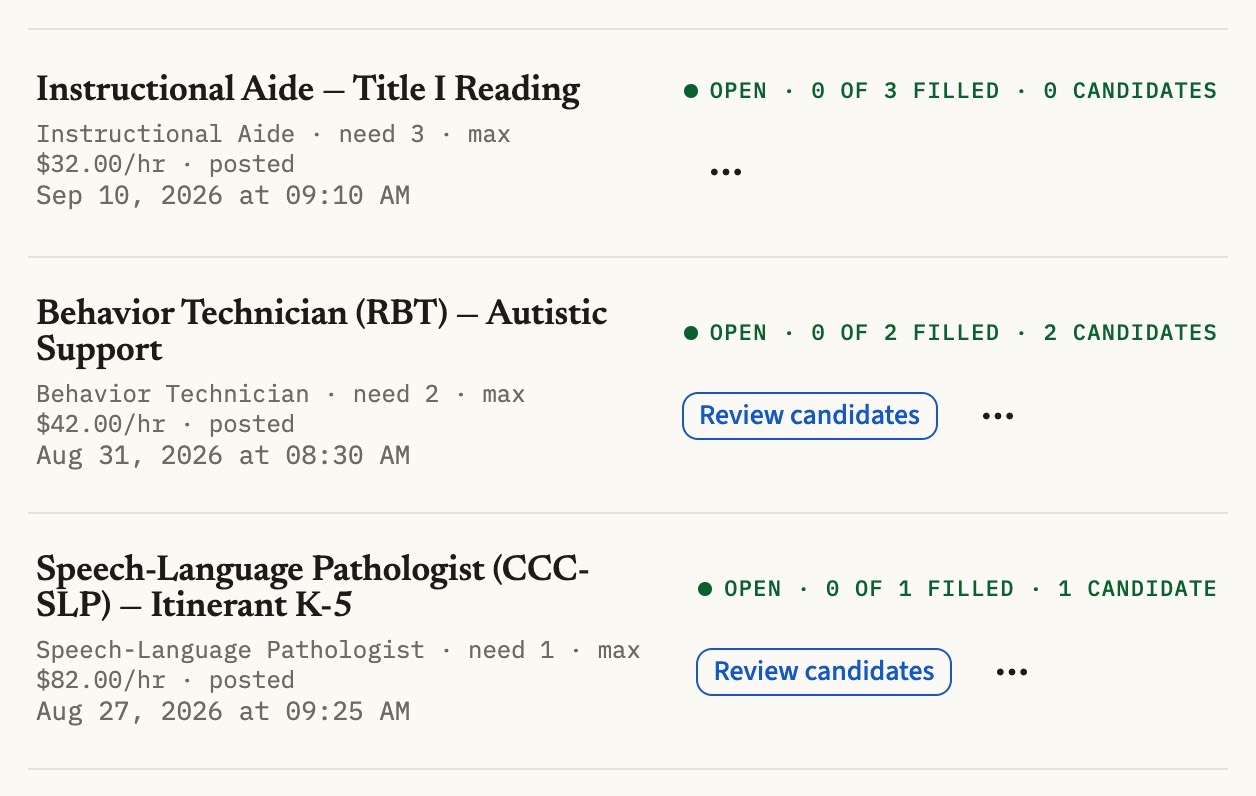
You send the need to one contact. Every approved agency sees it the same minute. We chase the submissions, the interview times, and the no-shows, and tell you where each seat stands without being asked.
For charter schools
At most charter schools the operations director is also HR, compliance, and the person who learns at 7:40 that the aide is not coming. Fullbench takes the agency coordination off that desk: one contact, every file approved before anyone starts, one invoice, across every agency you already use — free to your school.

What stops being yours
Nothing here asks you to hire anyone or to run a new system. Every agency you add brings its own contact, paperwork, timesheets, and invoice. Fullbench absorbs all four, and what reaches you is a decision.

One contact
You send the need to one contact. Every approved agency sees it the same minute. We chase the submissions, the interview times, and the no-shows, and tell you where each seat stands without being asked.
One file
You set which documents each role requires. Agencies upload them; you approve them item by item. Nobody is given a start date while anything is missing, expired, or still waiting on your review.
One invoice
Approved hours from every agency become one itemized invoice, each line traceable to a person, a day, a rate you set, and hours you approved. When something looks wrong there is one person to call.
Cleared before day one
Your board's list of required documents is the rule. Your state's clearances, TB screening, whatever else you require: the agency uploads each one and you approve it. The program holds the start date until every item has your approval.
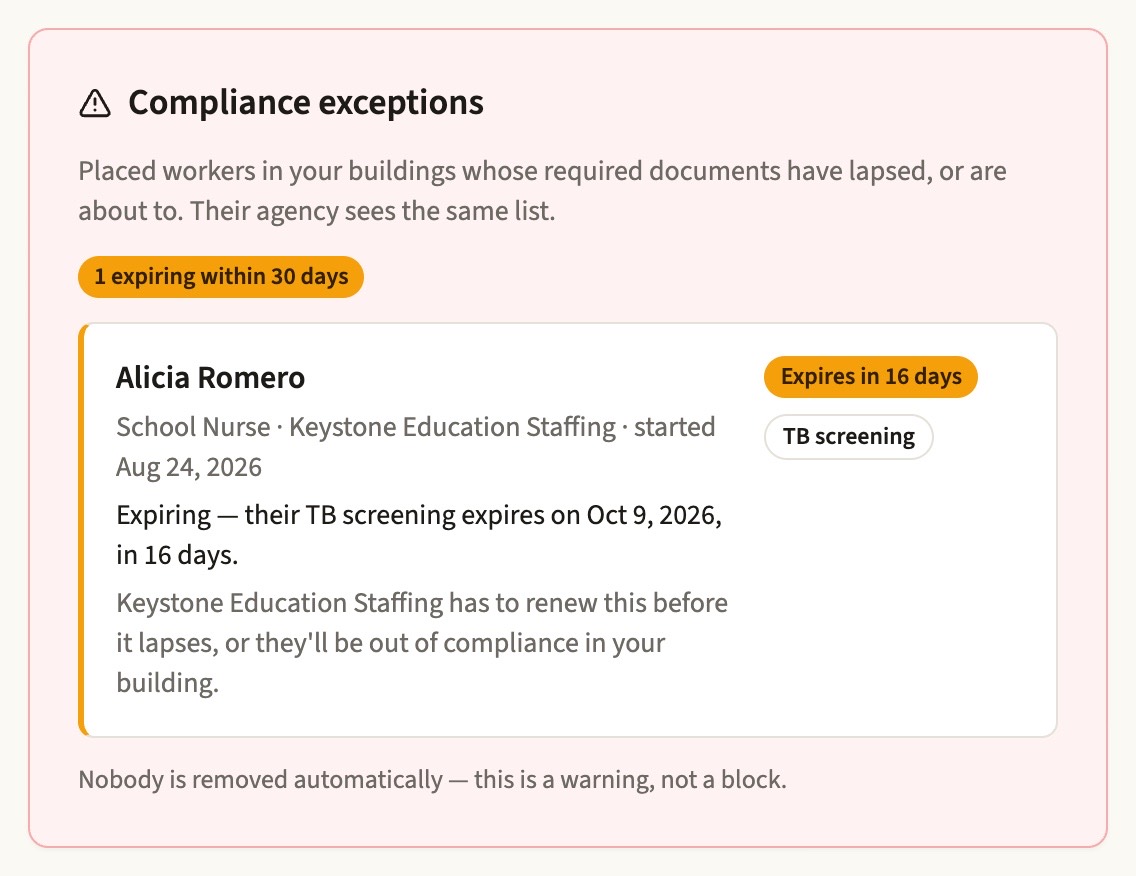
After the start, the same question is asked every day of the placement. Anyone working on a document that lapses within thirty days appears on your compliance screen and on the agency's, and both of you are emailed. Nobody is pulled automatically; that decision stays yours.
The first month
There is no purchase order and nothing to install. Your agencies agree terms first, then your first opening goes to them, and the only part that needs you in the room is the first call.

What the schools say
“Consistently matched us with exceptional talent who have made a significant impact on our students’ learning experience.”
“Odyssey Charter School has enjoyed a fruitful and collaborative partnership over the past three years.”
From signed letters of recommendation written to our team by the schools we serve.
Who does what
One person at your school can approve candidates and hours; the program is set up to work that way. If your board or authorizer requires those two approvals to sit with different people, say so and we set that separation before anyone is seated.
This does not touch your daily sub coverage. Your own call list, or Frontline, Aesop, or Red Rover if you use one, keeps covering absences for the people you employ. Fullbench runs the outside agencies supplying people you do not.
Run by a team that staffs schools every day.
Questions
No. The program fits a single school as naturally as a district. It is scoped to your school: one address, one approval chain, one invoice, and one seat that can approve both candidates and hours if that is how your school is staffed. Nothing in it assumes a central office, and it costs your school nothing. If you run several campuses under one board, each campus is set up as its own site under one agreement and one invoice. There is a page for this: Fullbench for charter schools.
No — retention is the design. Your approved agencies keep supplying the same people under their own brands and rates; what changes is the shared workflow and record. Districts can introduce agencies they already trust.
Three things from you: your agency list, your rate ceilings, and the document types you require before someone works in a building. Most districts are posting within a week. Your agencies do their own setup — we onboard each one directly, and none of that work lands on your staff.
No. Fullbench manages your agency-supplied staff — postings, credentials, time, and invoicing across every agency you use. Your internal absence-management and sub-placement system keeps doing exactly what it does today for your own employees. Nothing about Frontline, Aesop, Red Rover, or a building secretary’s call list changes.
The agency stays responsible for engaging the person it supplies, on the basis it uses today: payroll and employment obligations for the people it employs, or its own contract terms where a related-services professional works that way. Coordinating the work through Fullbench does not change it. The district supervises the work; the platform administers the workflow between them. Nothing about your co-employment posture changes.
Every agency’s approved hours become one invoice. Workers clock in and out on the platform, your schools approve the time, and approved hours from every participating agency consolidate into a single itemized invoice per period — instead of separate bills in separate formats on separate cycles. Each line traces back to a placement, a rate you set, and school-approved hours, so your business office reconciles one document rather than five. The agency participation fee is deducted from each agency’s remittance after your district has paid; it is never added to the rate you approved.
Next step
Pick a 15-minute slot. The invite lands in your inbox before you close this.
Times show in your own timezone; we are in Eastern. If the calendar does not load on your district network, open it in a new tab or call (484) 482-8223.
A person replies the same business day, before 5pm ET, with two or three 15-minute slots. Here is the one-page version to forward to whoever else should be on the call.
Prefer to call? (484) 482-8223, weekdays 8 to 5 ET.