The phone tree, retired
A long-term opening today means calling agencies in order and waiting between calls. You send it once; every approved agency sees it the same minute, with the same information and the same rate ceiling.
Substitute and paraprofessional staffing
Every agency you added solved a coverage problem and created a coordination one. Fullbench keeps all of them and takes the coordination off your staff: one contact, every file approved before anyone starts, one clock, one invoice. Free to your district.
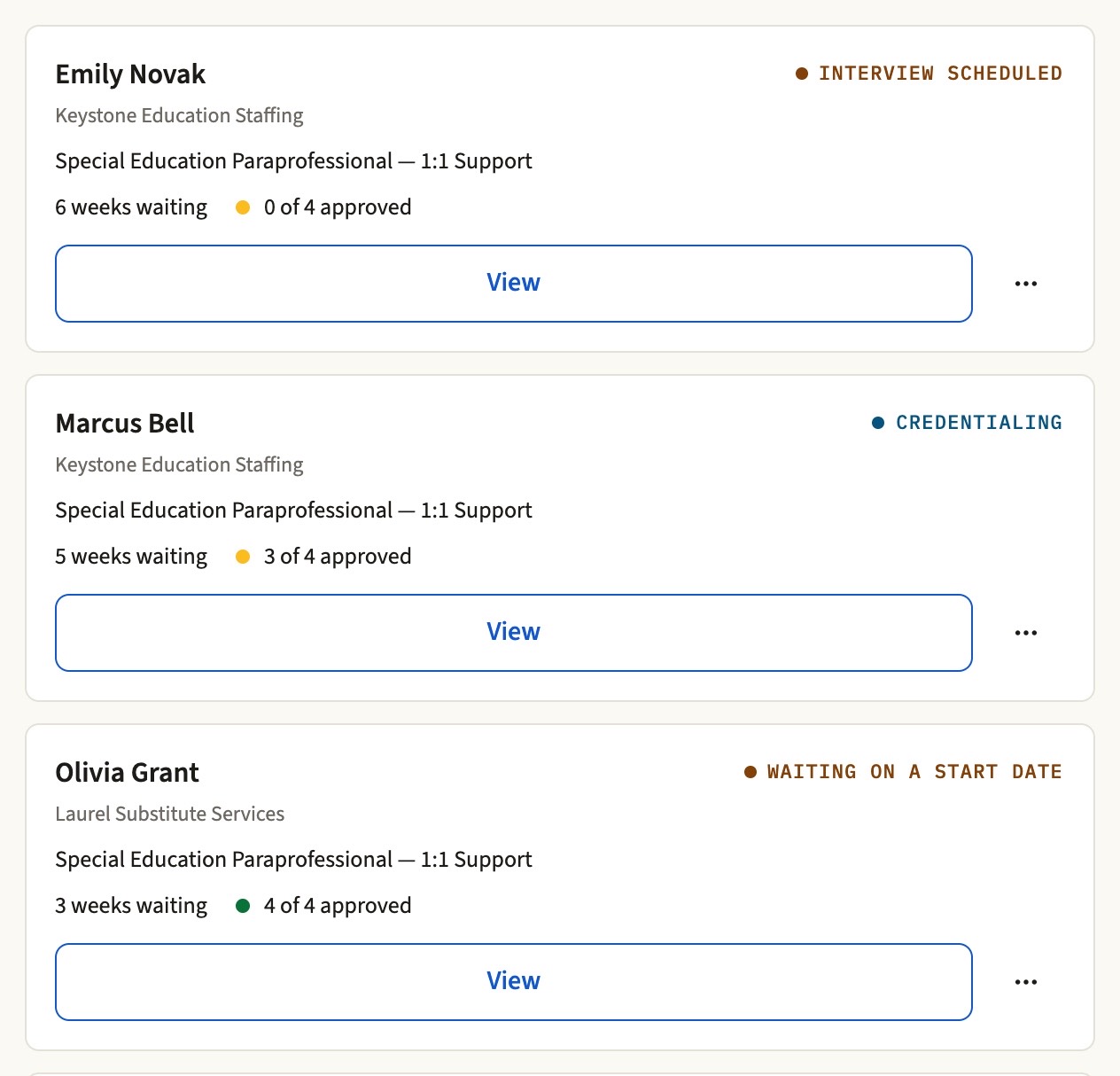

A district using several substitute and paraprofessional agencies has four options. It can administer each agency separately, name one agency as master vendor and let it subcontract the rest, license vendor management software and run the program in-house, or use a managed staffing program that runs the agencies on the district's behalf. Fullbench is the fourth. The district keeps every agency it already uses and the rates it approved; each opening reaches every approved agency at the same recorded instant; the district office approves every clearance; and the business office pays one invoice. Your daily-sub system (Frontline, Aesop, Red Rover) keeps covering absences for the people you employ, and Fullbench runs the outside agencies supplying the people you do not.
What changes
A long-term opening today means calling agencies in order and waiting between calls. You send it once; every approved agency sees it the same minute, with the same information and the same rate ceiling.
Your state's clearances (in Pennsylvania, Act 34 and 151), FBI fingerprinting, TB screening, whatever your board requires: the agency uploads, your office approves, and nobody starts until it has. A daily check warns you and the agency thirty days before anything lapses.
Approved hours from every agency become one itemized invoice, each line traceable to a person, a day, a building, and a rate. Your business office reconciles once and cuts one payment.
Every agency works the same opening under the same rules, so the scorecard means something: how often each responded, how fast, how many submissions became placements. At renewal you have a record, not an impression.

Who this fits
Run by a team that staffs schools every day. Here is what the program looks like for your district.
Questions
No — retention is the design. Your approved agencies keep supplying the same people under their own brands and rates; what changes is the shared workflow and record. Districts can introduce agencies they already trust.
Nothing — no software fee, no licences, no implementation charge, and no purchase order to raise. The program is funded by the agencies that participate in it. The order is what matters: your schools approve the hours, your district pays one consolidated invoice at the bill rates your own office approved, we remit each agency its share out of that payment, and the participation fee is deducted from the agency’s remittance. It happens on the agency’s side of the line and only after your payment has been collected, so nothing the program earns is ever added to a rate your district approved or taken out of district funds.
No. Fullbench manages your agency-supplied staff — postings, credentials, time, and invoicing across every agency you use. Your internal absence-management and sub-placement system keeps doing exactly what it does today for your own employees. Nothing about Frontline, Aesop, Red Rover, or a building secretary’s call list changes.
Three things from you: your agency list, your rate ceilings, and the document types you require before someone works in a building. Most districts are posting within a week. Your agencies do their own setup — we onboard each one directly, and none of that work lands on your staff.
Next step
Fifteen minutes on your roles, your rate ceilings and the agencies you already use, with the program open. No slides, no obligation, and no cost to your district.
What we cover
You leave with a clear next step. Nothing is signed on the call.
Pick a 15-minute slot. The invite lands in your inbox before you close this.
Times show in your own timezone; we are in Eastern. If the calendar does not load on your district network, open it in a new tab or call (484) 482-8223.
A person replies the same business day, before 5pm ET, with two or three 15-minute slots. Here is the one-page version to forward to whoever else should be on the call.
Prefer to call? (484) 482-8223, weekdays 8 to 5 ET.