Fullbench vs Q360
Both free to districts. Who actually competes for your openings, and whether the operator's own staffing affiliate plays by the same rules.
Compare · The Stepping Stones Group
Fullbench™ is a Stepping Stones Group (SSG) alternative for school districts that want every approved agency to receive each opening at the same recorded instant, one rate range per role approved by the district, and every file reviewed and approved before day one. Both are education MSPs at no direct cost to the district.
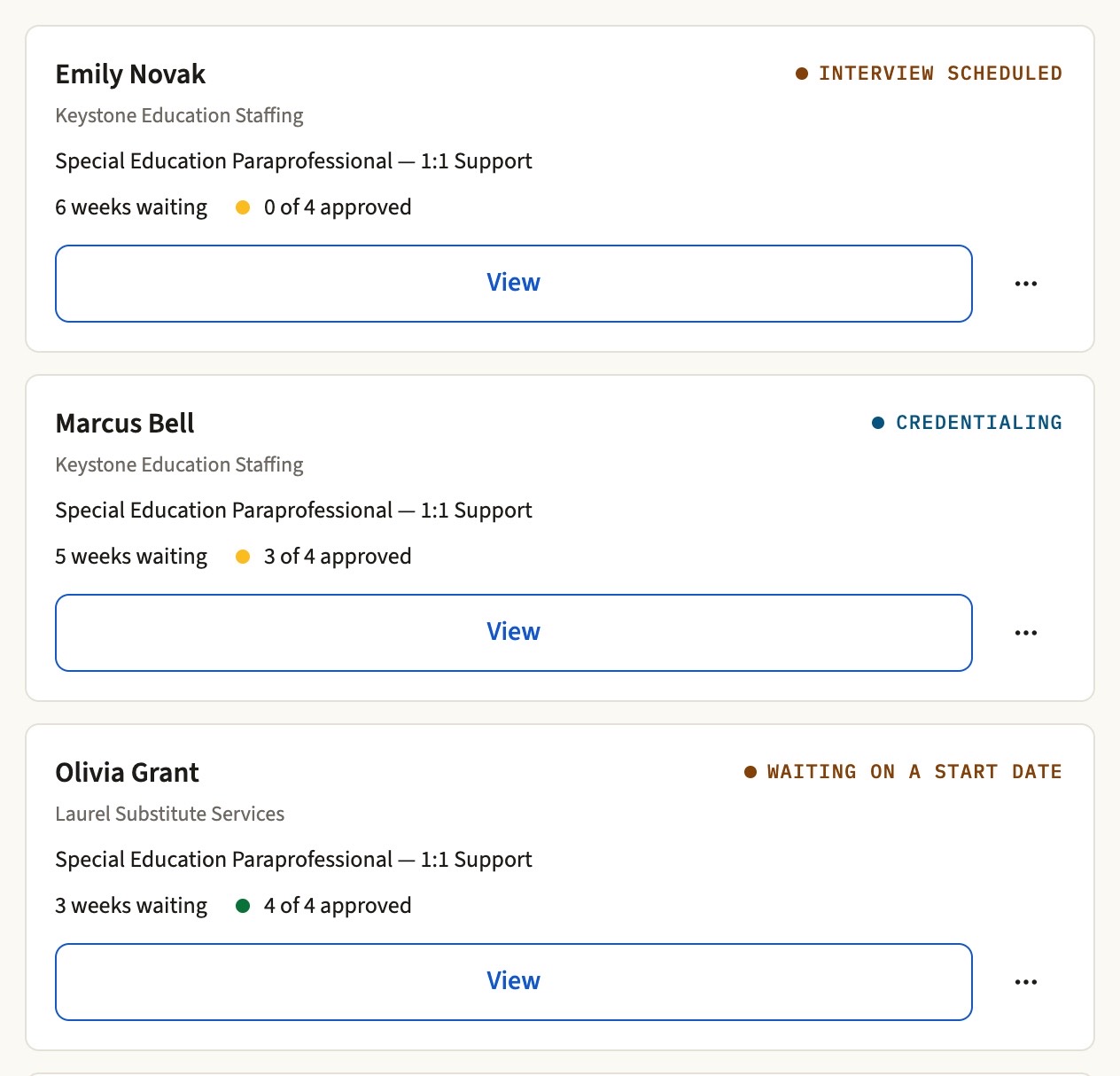
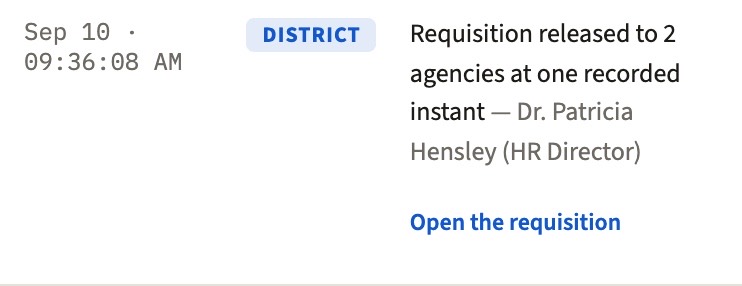
Side by side
Both coordinate a district’s staffing vendors through one point of contact and one invoice. SSG is also a large provider of school-based professionals in its own right. The differences are in who holds the controls.
| Question | Fullbench | The Stepping Stones Group (per its own published materials) |
|---|---|---|
| The model | A K-12 managed staffing provider (MSP) that runs every agency your district uses on the vendor management system it built for school staffing. | Describes itself as the nation’s largest education-specific workforce provider and an “education-native MSP.” Its MSP is powered by Trio VMS. |
| What the district pays | No program fee, no software fee. Your invoice carries exactly the rates your office approved. | “No direct cost to the district to implement” its MSP model, by its own FAQ. |
| Who works each opening | Every approved agency, released the opening at the same recorded instant and measured from that instant on one scorecard, including any agency close to the operator. | A “curated network of approved partners,” including local and regional providers. SSG also supplies school-based professionals itself; no published rule on how openings are distributed between its own staff and partner agencies was located as of October 2026. |
| Who sets the rate | Your office approves one rate range for each role, with no annual escalator. Every agency works inside it, and a submission outside the range is flagged the moment it arrives. | Describes “consolidated rates and invoicing” and “improving rate consistency.” A district-set ceiling on each opening was not described in the pages reviewed as of October 2026. |
| Who approves the file before day one | Fullbench reviews, approves and tracks each required document for your district, and your office can pull any reviewed file at any time. The software cannot set a start date while anything is missing, unreviewed or expired. | SSG centralizes credential verification, licensure tracking and compliance monitoring across all vendors in its VMS, with clinical oversight layered on. |
| Who advances a candidate | Only your district. No agency can move its own candidate a single step; every interview, offer and start date is your call. | Not described in the public materials reviewed as of October 2026. |
| Getting started | The agencies you name are onboarded in week one, and your first opening usually goes out in week two. Nothing to install. | Discovery and alignment, a customized implementation, then ongoing management. An implementation timeline was not published as of October 2026. |
Based on publicly available information as of October 2026: The Stepping Stones Group home page and its Managed Service Provider page and FAQ, listed with links below. “Not located” and “not described” refer to those public materials, not to SSG’s internal practices; district contract terms vary. The Stepping Stones Group and Trio VMS are trademarks of their owners. Spot an error? Tell us and we will correct it.
The takeaway
Questions
Yes. Both are education MSPs at no direct cost to the district. Fullbench releases every opening to every approved agency at the same recorded instant, holds every agency to the one rate range your office approves for each role, reviews and approves every required document, and refuses a start date until the file is approved.
By its own FAQ, there is no direct cost to the district to implement SSG’s MSP model. Fullbench also charges no program fee, and nothing is added to a rate your office approved.
Yes. Your agencies keep supplying the same people under their own brands, and you can add agencies you already trust. The program is exclusive for the roles it covers, so every agency that fills those roles works through it. Your office approves the roster, not the MSP.
Fullbench, for your district. Agencies upload each document once per person, and Fullbench reviews, approves and tracks every one. Your office decides which documents each role requires and can pull any reviewed file from the platform at any time. No start date can be set while anything is missing, unreviewed or expired, and a daily check warns you and the agency thirty days before a clearance lapses on anyone already working.
Trio VMS is the vendor management system The Stepping Stones Group’s MSP runs on. SSG says its program is “powered by Trio VMS” and that the VMS “unifies requisition management, vendor coordination, compliance oversight, timekeeping, billing, spend management, and performance monitoring into one structured system.” The Fullbench equivalent is Fullbench VMS: openings, candidates, credentials, time and one invoice, with every opening released to all approved agencies at the same recorded instant.
Comparison last verified 18 October 2026 against The Stepping Stones Group's own published materials.
Sources
Checked 18 October 2026. We compare only against what the other program publishes about itself — never against what a salesperson told us.
If anything here is out of date or wrong, tell us at hello@fullbench.co and we will correct it. The Stepping Stones Group is a trademark of its owner; this page exists for factual comparison.
Other comparisons
Both free to districts. Who actually competes for your openings, and whether the operator's own staffing affiliate plays by the same rules.
An Amergis-scale, cross-sector MSP versus an education-only program with published economics.
Licensed VMS software your staff operate versus an operated program. Who runs the workflow, and what it costs the district.
One company's bench at a negotiated markup, or every agency you approve working inside one rate range your office approved.
A single-employer program at a negotiated markup, versus many agencies competing on one release log — and what each lets a district check afterwards.
Two education MSPs at no direct cost to the district. What differs: who sees each opening and when, who sets the rate, and who approves the file before day one.
VMS software from Amergis that a district's staff run, or a K-12 MSP that runs every agency for you on its own VMS.
Neither charges the district. What differs: an order of preference versus one release to every agency, and who approves the file.
VMS software licensed by staffing agencies and MSPs, or a program a district joins directly with no program fee.
Absence software for the people you employ, or a K-12 MSP that runs every agency supplying the people you do not.
An enterprise VMS your HR and procurement teams operate, or a K-12 MSP that runs every agency for you with no program fee.
A contingent workforce system a program team configures, or a K-12 MSP and VMS that runs every agency for your district.
One substitute marketplace, or every substitute and paraprofessional agency you keep run as one program, with one invoice and no program fee.
One staffing agency that recruits and runs payroll for its own staff, or every agency you keep run as one program.
Source4Teachers now forwards to ESS: one substitute employer, or every agency you choose run as one program.
BlueSky is the software a staffing provider runs its school program on; Fullbench is the program and the software, answering to the district.
Aya Education fills from its own national network plus partners, on LotusOne; Fullbench releases every opening to all your agencies at one instant.
StaffBridge is K-12 VMS software, and says it is software only; Fullbench is the team that runs the program plus the VMS it runs on.
All comparisons, and what VMS, MSP and master vendor actually mean
Next step
Fifteen minutes on your roles, the rates you pay today and the agencies you already use, with the program open. No slides, no obligation, and no cost to your district.
What we cover
You leave with a clear next step. Nothing is signed on the call.
Pick a 15-minute slot. The invite lands in your inbox before you close this.
Times show in your own timezone; we are in Eastern. If the calendar does not load on your district network, open it in a new tab or use the contact form.
A person replies the same business day, before 5pm ET, with two or three 15-minute slots. Here is the one-page version to forward to whoever else should be on the call.
Prefer to write? Use the contact form; a person replies the same business day.