Keep every agency. Get one contract, one invoice, one contact.
Your agencies keep supplying the same people at the rates you approved. Fullbench runs everything in between: one contact for every request, every file approved before anyone starts, one invoice. Free to your district, and every hiring decision stays yours.
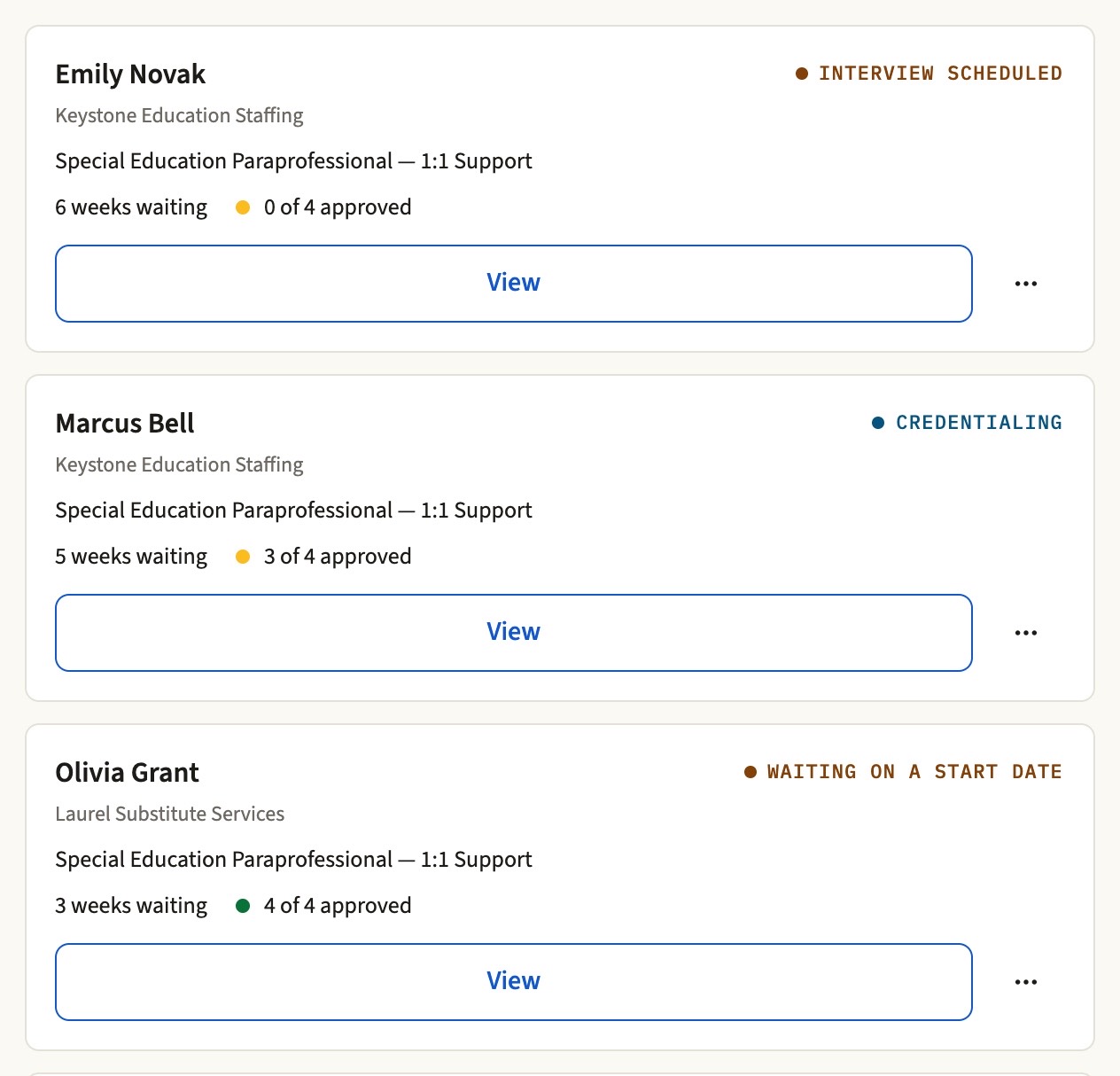
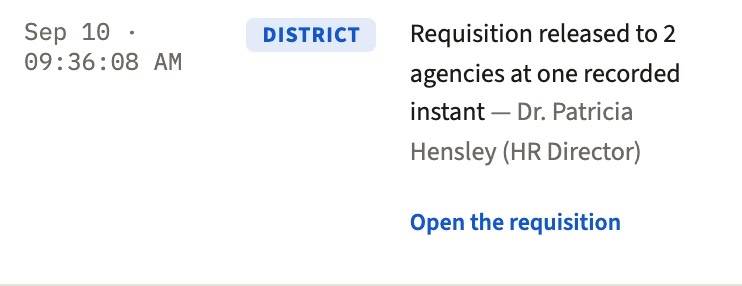
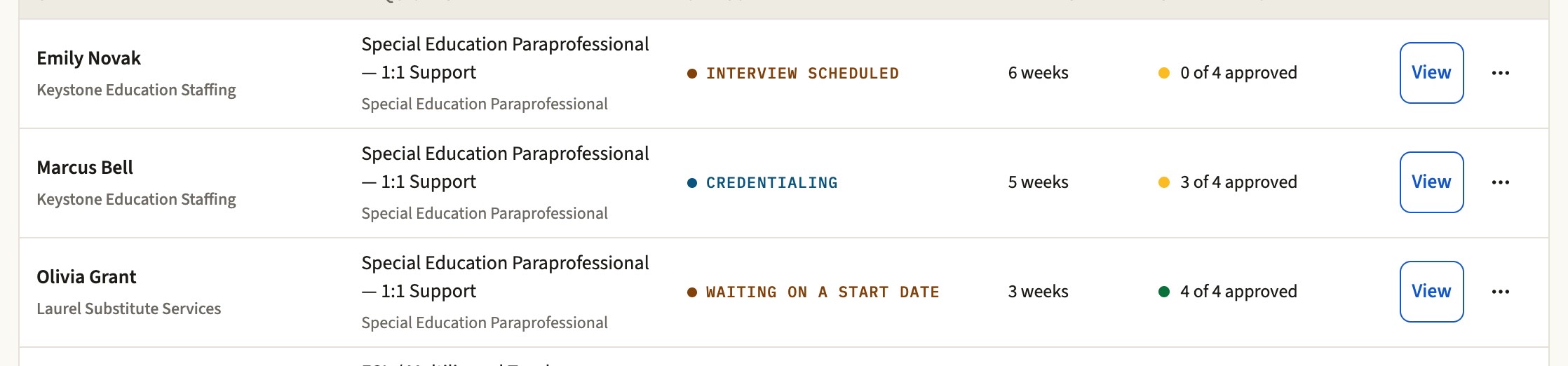
Your office's view: every candidate from every agency on one screen, and the recorded instant your opening reached all of them.Your office’s view: every candidate from every agency, on one screen.
Who chases what once the candidate is yours
The chasing is ours. What reaches you is a decision.
Posting the opening is the easy half. Candidate updates, missing documents, no-shows, invoice questions: that is the work landing on your staff today. Here is each piece, who owns it, and what your district sees while we do it.
We chase
You decide
Candidate updates
We follow every agency for submissions and answers. Your team advances or declines; no agency moves its own person forward. "Where are we on that para" is a page in your portal, with the history behind it, not a phone call.
We chase
You approve
Missing documents
The agency uploads. Your office approves or returns each item. We chase everything in between, and when you return a document the agency sees your reason against that requirement, so nobody guesses which file was wrong.
We sort it
You are told
No-shows and shift problems
A no-show, a clock time to correct, a shift worked that was never scheduled: bring it to one contact, not five agencies. Routine questions get a person within one business day. A coverage problem happening now, such as a no-show at 7:40, goes to the program line and we start working your agencies straight away, and we tell you where it stands rather than leaving you to chase it. A shift claimed outside the schedule is held until we verify it.
We answer
You pay once
Invoice questions
Every line traces to hours a school approved; a sheet sent back is not billed. When your business office questions a line, we answer it from the record. Your staff never reconcile across five agencies again.
Every candidate from every agency, longest waiting first. The Decide and Review buttons are your office's. Agencies cannot press them.
You see everything
Every rate, total spend, who is in your buildings today.
One screen for the whole program, with a name and a time on every decision. Because every agency starts from the same release instant, their numbers are comparable, and renewal conversations run on evidence.
Every rate. The ceiling you set on each opening, and every agency's rate under it. Over-ceiling submissions are flagged the moment they arrive.
Total spend. Approved hours at approved rates, by agency and by building, before the invoice arrives.
Who is in your buildings today. Every placed worker, the agency that supplied them, and whether their file is current. A daily check warns you and the agency thirty days before a clearance lapses.
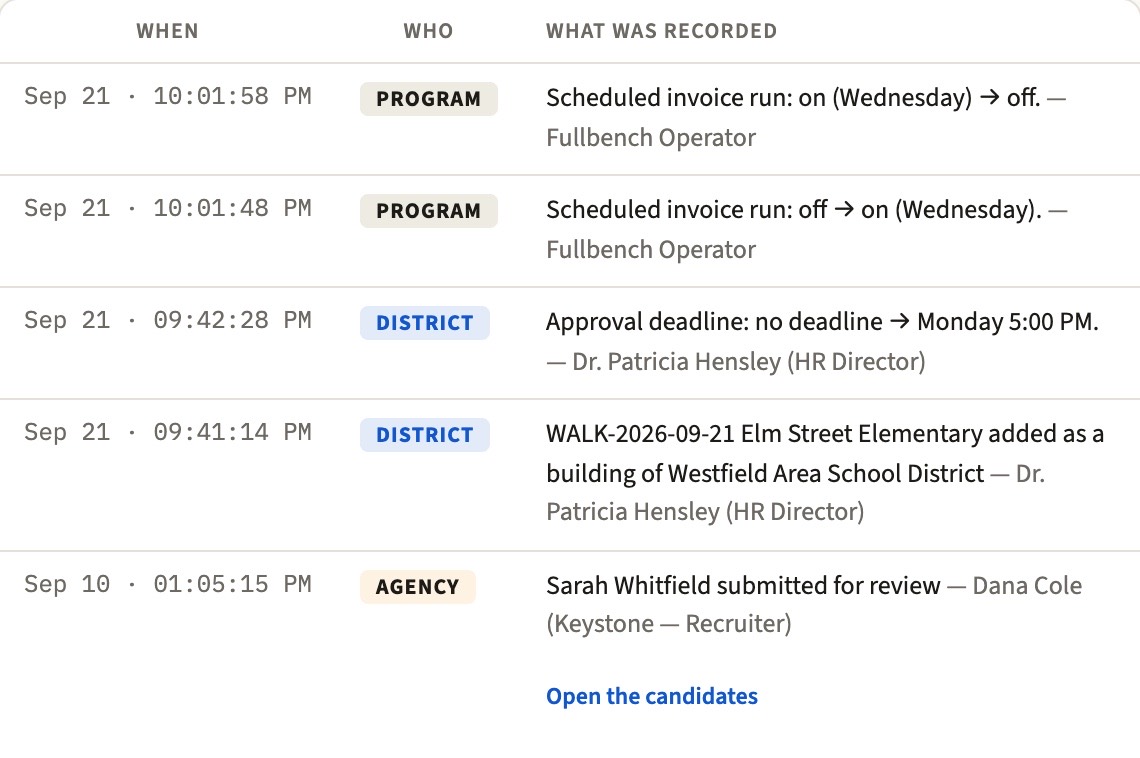
The record. Every release, approval, and hour in the order it happened, with who did it. Quote it at a board meeting or export it whenever you ask.
The program record. Who did what, when, and what let them. Exportable at any time, without asking us.
Every approved agency on one scorecard. Response time, fill, and win rate, measured from the same release instant.
What changes, what doesn't
One contact, one contract, one invoice. Every decision yours.
One participation agreement covers every agency you use; add or remove one without a new contract. Between the request and the invoice, four things happen, and your staff run none of them.
You send the need to one contact. A call, a note, or a line typed into the portal. Nobody learns a system to start.
Every approved agency sees it the same minute. The whole bench works your opening, not one agency at a time, under the ceiling you set.
Your office approves the file before day one. The program holds the start date until every required document has your approval on it.
Your schools approve the hours; you pay one invoice. One clock for every agency's people. Only approved hours reach the bill. Nothing is added to the rate you approved.
The agencies you already trust. You approve the roster. Exclusive, preferred, or non-exclusive is your selection in the agreement.
Every hiring decision. Agencies submit; your office interviews, chooses, and sets every start date.
Every rate ceiling. The maximum bill rate on each opening is your number, with no annual escalator.
Your data. Assignment history, rates, and approval records export in full whenever you ask.
Fit
Worth a conversation if this sounds like your week.
More than one agency, and no two of them work the same way.
Someone keeps agency staff clearances in a spreadsheet, and finds out late when one has lapsed.
Your business office matches timesheets to invoices by hand, in five formats on five cycles.
A special education or related-services seat has stayed open long enough that compensatory minutes are a real number.
You would add a specialist supplier if it did not mean another contract, another portal, another invoice.
Run by a team that staffs schools every day. A single-campus charter school? The program is written up for you at Fullbench for charter schools.
The seat an IEP is waiting on is where the program shows first.
What the schools say
Districts put it in writing.
“Over the past year, they have demonstrated a consistent level of professionalism, reliability, and responsiveness in addressing our staffing needs.”
Lennita Porter-LinenDirector of Human Resources, Recruitment and Retention · Bridgeton Public Schools, NJ
“An invaluable partner in ensuring the continuity of education in our school.”
Dr. David WeathingtonChief Executive Officer · Buttonwood Farms / Delta School, Philadelphia PA
From signed letters of recommendation written to our team by the schools we serve.
What you can hold us to
Six rules, written into the agreement you sign.
01
Every agency sees every opening at once
Released to all approved agencies at the same recorded time. The release record cannot be edited afterwards.
02
Only your district advances a candidate
We pre-screen the file for completeness. Your team decides who interviews, who is offered, and who starts. No agency can move its own candidate.
03
No start on an unapproved file
A document submitted but not yet reviewed blocks the start date. The approval is your office's, with a name and a time on it.
04
You set the ceiling
The maximum bill rate on every posting is your number. Nothing is added to it, and there is no annual escalator.
05
Exclusivity is your selection
Exclusive, preferred, or non-exclusive is chosen by your district in the agreement. Your own employees and direct applicants sit outside it either way.
06
Hire them onto your staff
Move anyone working through the program onto district payroll, free past the threshold in the agreement. The schedule is handed to you at the first meeting, not at signature.
Questions
Common questions
Does this replace our current agencies?
No — retention is the design. Your approved agencies keep supplying the same people under their own brands and rates; what changes is the shared workflow and record. Districts can introduce agencies they already trust.
What does it cost the district?
Nothing — no software fee, no licences, no implementation charge, and no purchase order to raise. The program is funded by the agencies that participate in it. The order is what matters: your schools approve the hours, your district pays one consolidated invoice at the bill rates your own office approved, we remit each agency its share out of that payment, and the participation fee is deducted from the agency’s remittance. It happens on the agency’s side of the line and only after your payment has been collected, so nothing the program earns is ever added to a rate your district approved or taken out of district funds.
Do we have to replace our ERP or payroll?
No. Fullbench runs the staffing loop — the request, the candidates, the credential file, the hours and the invoice — alongside the systems you already have. Nothing to install, nothing to migrate, and your program record exports in full whenever you ask.
Is Fullbench vendor-neutral?
Neutral in a way your office can check, not one you have to take on faith. Every approved agency receives the same opening at the same recorded instant, so no agency gets a head start, and every agency is scored in the same scorecards from that same instant. Fullbench does not employ the workers — your agencies do. Fullbench checks each submission against your own required list — every document present, in date and legible, anyone missing one held back. Your own team makes every hiring decision; no agency can advance its own candidate, and the release timestamp, with a name attached, is the record you can audit. The team that runs this program also participates in the program as a staffing agency, and it competes under exactly the same rules as every other agency: the same release instant, the same scorecard, no view of any other agency’s candidates or rates, and your district’s final say on every candidate.
How does consolidated invoicing work across multiple staffing agencies?
Every agency’s approved hours become one invoice. Workers clock in and out on the platform, your schools approve the time, and approved hours from every participating agency consolidate into a single itemized invoice per period — instead of separate bills in separate formats on separate cycles. Each line traces back to a placement, a rate you set, and school-approved hours, so your business office reconciles one document rather than five. The agency participation fee is deducted from each agency’s remittance after your district has paid; it is never added to the rate you approved.
Who employs the worker — and who carries the liability?
The agency stays responsible for engaging the person it supplies, on the basis it uses today: payroll and employment obligations for the people it employs, or its own contract terms where a related-services professional works that way. Coordinating the work through Fullbench does not change it. The district supervises the work; the platform administers the workflow between them. Nothing about your co-employment posture changes.
Pick a 15-minute slot. The invite lands in your inbox before you close this.
Times show in your own timezone; we are in Eastern. If the calendar does not load on your district network, open it in a new tab or call (484) 482-8223.
Your request is in.
A person replies the same business day, before 5pm ET, with two or three 15-minute slots. Here is the one-page version to forward to whoever else should be on the call.
What happens next
You pick a slot; the invite is in your inbox immediately.
On the call we open the platform on your roles and the agencies you already use.
If it fits, we start with one department. Nothing is signed on the call.