Fullbench vs Q360
Both free to districts. Who actually competes for your openings, and whether the operator's own staffing affiliate plays by the same rules.
Compare · SAP Fieldglass
Fullbench™ is an SAP Fieldglass alternative built for school districts. SAP Fieldglass is an enterprise vendor management system for external workers, run by an organization’s own HR, procurement and talent teams. Fullbench is a K-12 managed staffing provider (MSP) with its own VMS: our team runs every staffing agency your district uses, with no program fee.

Side by side
SAP Fieldglass is built for organizations that manage contractors, consultants and service providers across many categories and countries. Fullbench is built for one thing: the agencies that staff your schools. Here is what that changes for your office.
| Question | Fullbench | SAP Fieldglass (per SAP’s own published materials) |
|---|---|---|
| The model | A K-12 managed staffing provider (MSP) that runs every agency your district uses on the vendor management system it built for school staffing. | “Cloud-based, external workforce management software” for contingent workers and service providers, with contingent workforce management, services procurement and worker profile management. |
| Who it is built for | K-12 school districts and charter schools: special education, related services, paraprofessionals, nursing and substitutes. | “All categories, from field services and maintenance to engineering, construction, and corporate/professional services,” localized for 180+ countries and 21 languages. A K-12 edition was not located as of October 2026. |
| Who runs the program every day | Our team: agency onboarding, every release, the chasing, the document follow-up, billing and remittances. Your office makes the decisions. | “HR, procurement, and talent management teams” in the organization that licenses it. |
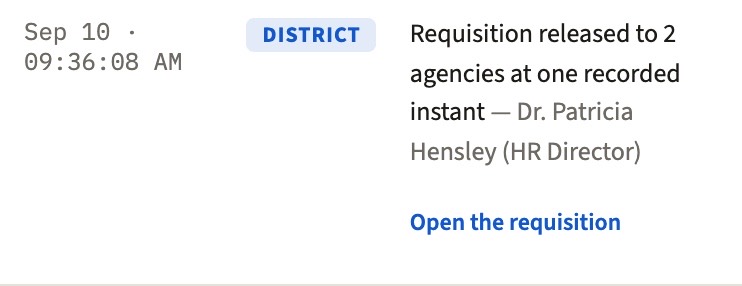
| Who works each opening | Every approved agency, released the opening at the same recorded instant and measured from that instant on one scorecard. | Helps organizations “source, engage, and manage external talent.” A published rule on release order or timing was not located as of October 2026. |
| What stops an uncleared start | Fullbench reviews, approves and tracks each required document for your district: certification, clearances, fingerprinting, whatever your board requires. No start date can be set while anything is missing, unreviewed or expired. | Automated compliance tools and localization for “local labor and tax laws.” A school-clearance workflow was not located as of October 2026. |
| Who sets the rate | Your office approves one rate range for each role, with no annual escalator. Every agency works inside it. | “Sophisticated rate management” for complex rate scenarios, with dynamic lookups. |
| What it costs | No program fee to the district: no software fee, no per-seat fee, no implementation charge. | Pricing “varies based on an organization’s needs,” with annual subscriptions and consumption-based pricing. |
Based on publicly available information as of October 2026: SAP’s “What is SAP Fieldglass?” page and its workforce management page, listed with links below. “Not located” refers to those public materials, not to SAP’s internal practices. SAP and SAP Fieldglass are trademarks of their owner. Spot an error? Tell us and we will correct it.
The takeaway
Questions
Yes. SAP Fieldglass is an enterprise vendor management system that an organization’s HR, procurement and talent teams run. Fullbench is a K-12 managed staffing provider (MSP) with its own VMS: our team runs every staffing agency your district uses, and your district pays no program fee.
SAP describes Fieldglass as used by organizations of all sizes and industries, across categories from field services and maintenance to engineering, construction and professional services. A K-12 edition was not located in its public materials as of October 2026. Fullbench is built only for K-12 districts and charter schools.
SAP says Fieldglass pricing varies with an organization’s needs, with annual subscription and consumption-based models. Fullbench charges the district no program fee: no software fee, no per-seat fee and no implementation charge.
No. Our team onboards your agencies, releases every opening, chases submissions and documents, and builds one invoice. Your office makes the decisions: which candidate, which documents each role requires, which hours. The agencies you name are onboarded in week one, and your first opening usually goes out in week two.
Comparison last verified 19 October 2026 against SAP's own published materials.
Sources
Checked 19 October 2026. We compare only against what the other program publishes about itself — never against what a salesperson told us.
If anything here is out of date or wrong, tell us at hello@fullbench.co and we will correct it. SAP Fieldglass is a trademark of its owner; this page exists for factual comparison.
Other comparisons
Both free to districts. Who actually competes for your openings, and whether the operator's own staffing affiliate plays by the same rules.
An Amergis-scale, cross-sector MSP versus an education-only program with published economics.
Licensed VMS software your staff operate versus an operated program. Who runs the workflow, and what it costs the district.
One company's bench at a negotiated markup, or every agency you approve working inside one rate range your office approved.
A single-employer program at a negotiated markup, versus many agencies competing on one release log — and what each lets a district check afterwards.
Two education MSPs at no direct cost to the district. What differs: who sees each opening and when, who sets the rate, and who approves the file before day one.
VMS software from Amergis that a district's staff run, or a K-12 MSP that runs every agency for you on its own VMS.
Two education MSPs at no direct cost to the district. What differs: who curates the agencies, who sets the rate, and who approves the file.
Neither charges the district. What differs: an order of preference versus one release to every agency, and who approves the file.
VMS software licensed by staffing agencies and MSPs, or a program a district joins directly with no program fee.
Absence software for the people you employ, or a K-12 MSP that runs every agency supplying the people you do not.
A contingent workforce system a program team configures, or a K-12 MSP and VMS that runs every agency for your district.
One substitute marketplace, or every substitute and paraprofessional agency you keep run as one program, with one invoice and no program fee.
One staffing agency that recruits and runs payroll for its own staff, or every agency you keep run as one program.
Source4Teachers now forwards to ESS: one substitute employer, or every agency you choose run as one program.
BlueSky is the software a staffing provider runs its school program on; Fullbench is the program and the software, answering to the district.
Aya Education fills from its own national network plus partners, on LotusOne; Fullbench releases every opening to all your agencies at one instant.
StaffBridge is K-12 VMS software, and says it is software only; Fullbench is the team that runs the program plus the VMS it runs on.
All comparisons, and what VMS, MSP and master vendor actually mean
Next step
Fifteen minutes on your roles, the rates you pay today and the agencies you already use, with the program open. No slides, no obligation, and no cost to your district.
What we cover
You leave with a clear next step. Nothing is signed on the call.
Pick a 15-minute slot. The invite lands in your inbox before you close this.
Times show in your own timezone; we are in Eastern. If the calendar does not load on your district network, open it in a new tab or use the contact form.
A person replies the same business day, before 5pm ET, with two or three 15-minute slots. Here is the one-page version to forward to whoever else should be on the call.
Prefer to write? Use the contact form; a person replies the same business day.