Fullbench vs Q360
Both free to districts. Who actually competes for your openings, and whether the operator's own staffing affiliate plays by the same rules.
Compare · GHR Education
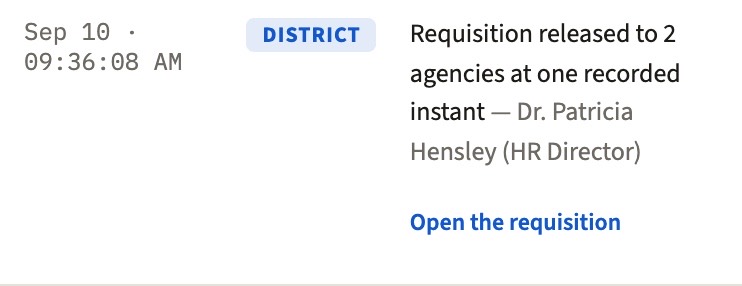
Fullbench™ is a GHR Education alternative for school districts that want every opening released to every approved agency at the same recorded instant, every time, with one rate range per role approved by the district and no start date while any required document is missing, unreviewed or expired. Neither program charges the district.

Side by side
Both coordinate a district’s agencies through one point of contact, one contract and one invoice. GHR Education is also a staffing company that places its own therapists, nurses and behavioral staff. The differences are in the rules.
| Question | Fullbench | GHR Education (per its own published materials) |
|---|---|---|
| The model | A K-12 managed staffing provider (MSP) that runs every agency your district uses on the vendor management system it built for school staffing. | A managed services program from GHR Education, the school staffing division GHR launched in 2011, which places therapists, school nurses, school psychologists, social workers and behavioral staff. |
| What the district pays | No program fee: no software fee, no per-seat fee, no implementation charge. Nothing is added to a rate your office approved. | “GHR Education’s Managed Services does not charge the district,” by its own FAQ. |
| Who works each opening | Every approved agency, every opening, released at the same recorded instant. One rule, the same for every agency, including any agency close to the operator. | The district “can distribute needs to agencies in order of preference – or all at once to everyone,” by its own FAQ. Its MSP page says GHR provides “a curated pool of qualified talent” and also coordinates with the district’s other agencies. |
| Who sets the rate | Your office approves one rate range for each role, with no annual escalator. Every agency works inside it, and a submission outside the range is flagged the moment it arrives. | GHR will identify the district’s vendors and “the costs they charge for services, and provide areas for improvement.” A district-set ceiling on each opening was not described in the pages reviewed as of October 2026. |
| What stops an unapproved start | Fullbench reviews, approves and tracks each required document for your district, and your office can pull any reviewed file at any time. The software cannot set a start date while anything is missing, unreviewed or expired. | Everyone furnished through the MSP has their credentials “in the same format, in one place.” A rule that refuses a start date until the district approves the file was not located as of October 2026. |
| Contract and invoice | One participation agreement covers every agency you use. One itemized invoice, each line traceable to a placement, a rate inside your approved range and hours a school approved. | Participating vendors sign “one, uniform contract,” and the district receives “one weekly invoice for all personnel furnished by all affiliate vendors.” |
| The record at renewal | Every agency measured from the same release instant: response time, submissions, placements and win rate on one scorecard. Every release, approval and hour carries a name and a time. | Reports show which vendors are most effective, and underperforming vendors can be replaced, by its own FAQ. |
Based on publicly available information as of October 2026: the GHR Education Managed Services page and FAQ and its Why GHR page, listed with links below. “Not located” and “not described” refer to those public materials, not to GHR’s internal practices; district contract terms vary. GHR and GHR Education are trademarks of their owner. Spot an error? Tell us and we will correct it.
The takeaway
Questions
Yes. Neither program charges the district. Fullbench releases every opening to every approved agency at the same recorded instant, every time, holds every agency to the one rate range your office approves for each role, reviews and approves every required document, and refuses a start date until the file is approved.
By its own FAQ, GHR Education’s Managed Services does not charge the district. Fullbench charges no program fee either, and nothing is added to a rate your office approved.
One way, every time: each opening is released to every agency your district has approved at the same recorded instant, and every agency is measured from that instant on one scorecard. No agency, including any agency close to the operator, sees an opening before another.
Yes. You send the roles you fill through agencies, the agencies you use, the documents you require and who approves; one onboarding call of about an hour confirms it. The agencies you named are onboarded in week one, and your first opening usually goes out in week two.
Comparison last verified 18 October 2026 against GHR Education's own published materials.
Sources
Checked 18 October 2026. We compare only against what the other program publishes about itself — never against what a salesperson told us.
If anything here is out of date or wrong, tell us at hello@fullbench.co and we will correct it. GHR Education is a trademark of its owner; this page exists for factual comparison.
Other comparisons
Both free to districts. Who actually competes for your openings, and whether the operator's own staffing affiliate plays by the same rules.
An Amergis-scale, cross-sector MSP versus an education-only program with published economics.
Licensed VMS software your staff operate versus an operated program. Who runs the workflow, and what it costs the district.
One company's bench at a negotiated markup, or every agency you approve working inside one rate range your office approved.
A single-employer program at a negotiated markup, versus many agencies competing on one release log — and what each lets a district check afterwards.
Two education MSPs at no direct cost to the district. What differs: who sees each opening and when, who sets the rate, and who approves the file before day one.
VMS software from Amergis that a district's staff run, or a K-12 MSP that runs every agency for you on its own VMS.
Two education MSPs at no direct cost to the district. What differs: who curates the agencies, who sets the rate, and who approves the file.
VMS software licensed by staffing agencies and MSPs, or a program a district joins directly with no program fee.
Absence software for the people you employ, or a K-12 MSP that runs every agency supplying the people you do not.
An enterprise VMS your HR and procurement teams operate, or a K-12 MSP that runs every agency for you with no program fee.
A contingent workforce system a program team configures, or a K-12 MSP and VMS that runs every agency for your district.
One substitute marketplace, or every substitute and paraprofessional agency you keep run as one program, with one invoice and no program fee.
One staffing agency that recruits and runs payroll for its own staff, or every agency you keep run as one program.
Source4Teachers now forwards to ESS: one substitute employer, or every agency you choose run as one program.
BlueSky is the software a staffing provider runs its school program on; Fullbench is the program and the software, answering to the district.
Aya Education fills from its own national network plus partners, on LotusOne; Fullbench releases every opening to all your agencies at one instant.
StaffBridge is K-12 VMS software, and says it is software only; Fullbench is the team that runs the program plus the VMS it runs on.
All comparisons, and what VMS, MSP and master vendor actually mean
Next step
Fifteen minutes on your roles, the rates you pay today and the agencies you already use, with the program open. No slides, no obligation, and no cost to your district.
What we cover
You leave with a clear next step. Nothing is signed on the call.
Pick a 15-minute slot. The invite lands in your inbox before you close this.
Times show in your own timezone; we are in Eastern. If the calendar does not load on your district network, open it in a new tab or use the contact form.
A person replies the same business day, before 5pm ET, with two or three 15-minute slots. Here is the one-page version to forward to whoever else should be on the call.
Prefer to write? Use the contact form; a person replies the same business day.