

The education workforce network

Every staffing partner. One accountable program.

Your approved agencies keep supplying the same people — through one governed workflow: requisitions, candidates, credentials, time, billing, and performance. Transparent rules. The district in control.

Free to districts — no software fees, no seat licenses, no implementation charge.

$0 to districts

No software fees, seat licenses, or implementation charge.

One recorded instant

Every requisition reaches every approved agency at the same timestamp.

Credential-gated starts

No start date until the district approves the file. A gate, not a memo.

Same-clock scorecards

Response, fill, and win rate measured identically for every agency.

The problem

Five agencies, five workflows, zero shared record

Districts that rely on multiple staffing agencies run the same hire five different ways — by email, spreadsheet, and phone. Nobody sees the whole program, and nobody can prove it was fair.

The scattered requisition

The same opening goes out by email at five different times, in five different formats. Whoever heard first wins — and there's no record of who heard when, or what was actually asked for.

The credential scramble

Clearances live in inboxes and shared drives. A start date gets promised before the file is complete, and the district finds out after the person is already in the building.

The invoice pile

Every agency bills its own way, on its own cycle, against time nobody centrally approved. Reconciliation eats days, and rate creep hides in the noise.

How it works

One loop, from need to remittance

Eight steps of live software — every one writes to the same record, and every agency plays by the same recorded rules.

Post a need once

Role, schools, headcount, max bill rate, submission cap.

Simultaneous release

Every approved agency sees it at one recorded instant.

Agencies compete

Their candidates, their rates — over-ceiling flagged on arrival.

The district drives status

Interview, offer, acceptance — agencies can't advance their own.

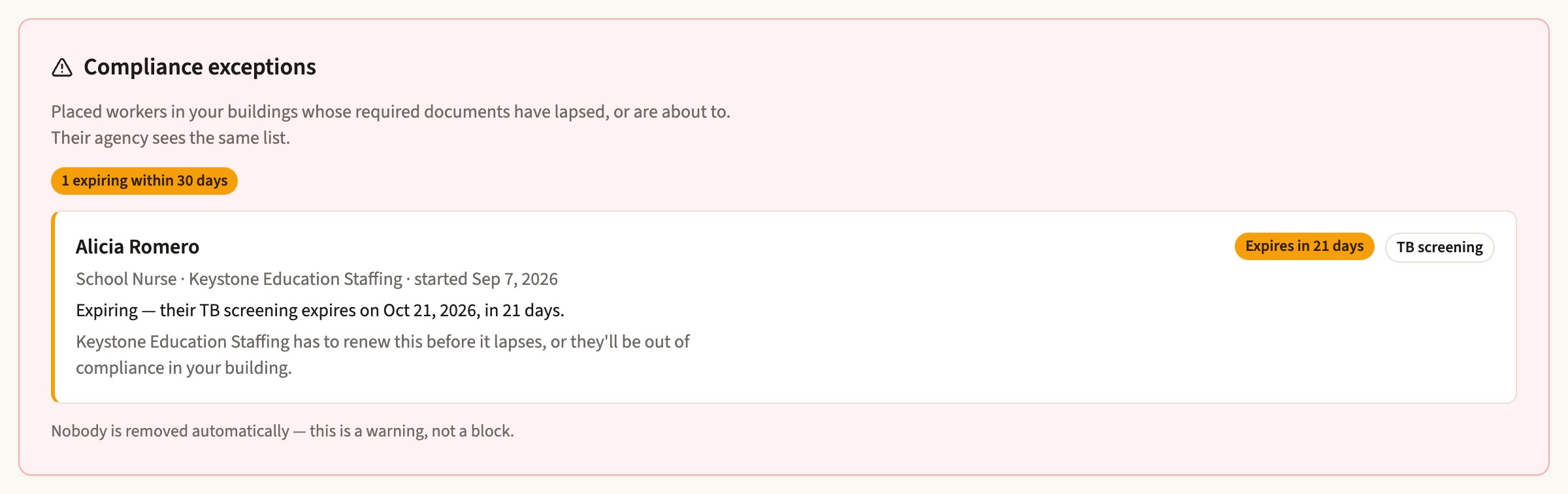
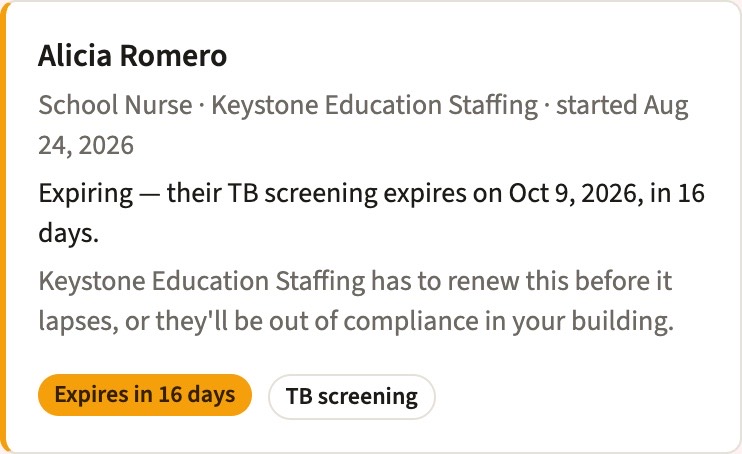
Credentials gate the start

No start date while any document awaits review.

Placement locks the rate

What was agreed is what gets billed.

Approved time → one invoice

Clock-in, school approval, one consolidated document.

Collection → remittance

Agencies paid after you pay; the fee deducted at collection.

Inside the platform

Built like enterprise software, because it is

Everything below is live product — the pipeline your HR team works in, the scorecards your agencies are measured on, and the remittance ledger that proves where every dollar went.

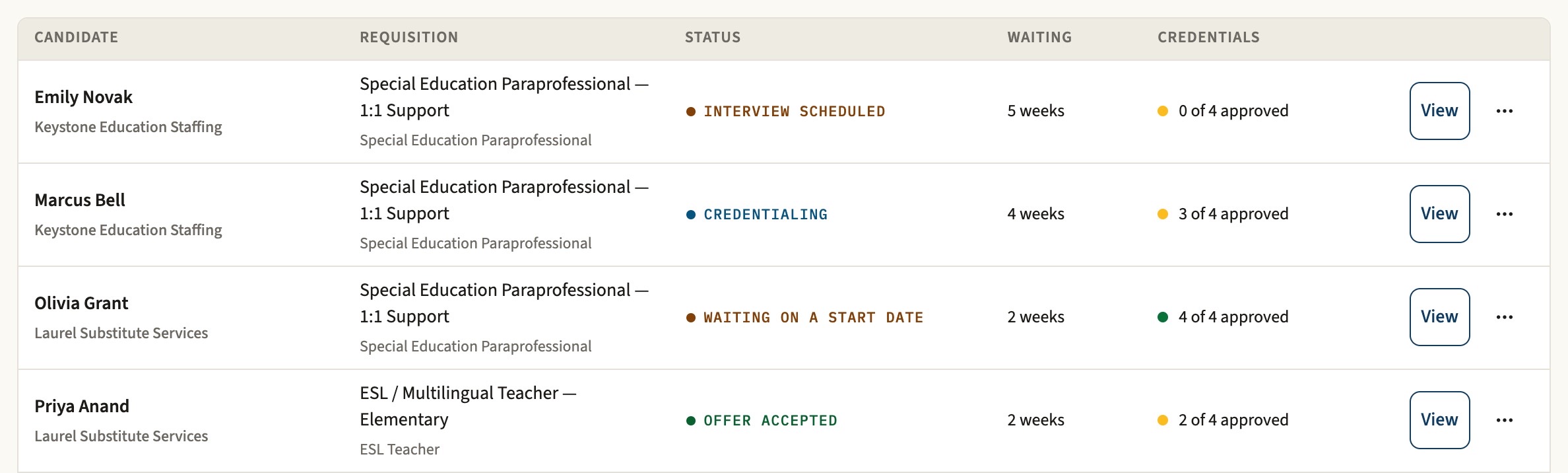
The candidate pipeline

Every submission from every agency in one district-controlled queue. Statuses move only when your team moves them.

The remittance ledger

Collection triggers remittance, itemized to the line. The fee is visible, published, and deducted only when your payment lands.

Agency scorecards — measured on the same clock

Because every agency receives every requisition at the same recorded instant, response time, fill speed, and win rate are finally comparable. Renewal conversations get a lot shorter.

The record

Every row below is a recorded fact — who, what, when. Releases, submissions, credential decisions, start dates, collections. When a question comes up in a board meeting, the answer is a lookup, not a meeting.

Economics

The fee, in plain sight

Districts pay nothing. Agencies pay a published participation fee — deducted only when the district's payment is collected.

Districts

$0

Forever. Not a trial, not a tier.

  • No software fees
  • No seat licenses
  • No implementation charge

How it's funded

Agencies

3–5% participation fee

Published rate, applied to collected billings.

  • Deducted when payment is collected
  • Never invoiced up front
  • Itemized on every remittance

Everyone

One record

The same ledger, visible to both sides.

  • Agencies keep identity, people, and rates
  • Timestamped releases, submissions, and decisions
  • No exclusivity clause

Why earned-on-collection matters: agencies never fund the program ahead of the district. The fee exists only after the district's payment arrives — the platform's incentives sit on the same side of the table as everyone else's.

The stakes

Staffing is now a permanent operation, not an emergency

35%

of U.S. public schools reported at least one teacher vacancy as of October 2024.

74%

of public schools with vacancies reported difficulty filling them with fully certified teachers.

13,303

regular school districts in the United States — nearly all of them competing for the same people.

Source: National Center for Education Statistics.

Questions

Common questions

Does this replace our current agencies?

No — retention is the design. Your approved agencies keep supplying the same people under their own brands and rates; what changes is the shared workflow and record. Districts can introduce agencies they already trust.

What does it cost the district?

Nothing — no software fee, licenses, or implementation charge. The platform is funded by the published agency participation fee, collected only when the district has paid.

How is fairness between agencies enforced?

It's recorded, not promised: one recorded release instant for every agency, district-driven statuses (agencies can't advance their own candidates), credential gates — and a timestamp with a name on every release, submission, and credential decision.

All questions

Next step

Request a walkthrough

Thirty minutes on the live platform — your roles, your rate ceilings, your agencies' names on the screen. No slideware.

  • Watch a requisition release to every agency at one recorded instant
  • See the credential gate hold a start date until the file clears
  • Trace one invoice from approved time to itemized remittance

Book your 30 minutes

We'll reply within one business day.

No mailing lists. We use this only to schedule your walkthrough.