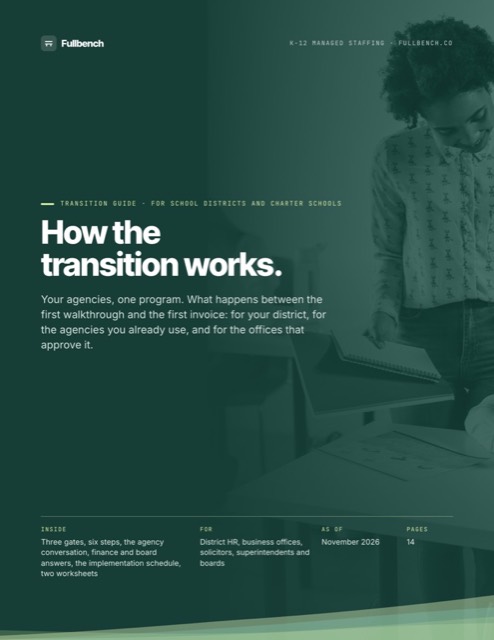
What happens between "interesting" and the first invoice: the district's approval path, the agency conversations we run for you, the questions finance and procurement ask, and your implementation schedule.
14 pages · about 10 min · for the person who has to explain the next steps to a business manager, a solicitor and a board
This guide is for the person who said "interesting" in the first meeting and now has to explain to a business manager, a solicitor, a director and a board what actually happens next. It is written in the order things happen.
Track 1: before anything is signed
Three readers, three documents. Each office says yes to a different thing. We prepare all three and answer every question in writing the day it is asked.
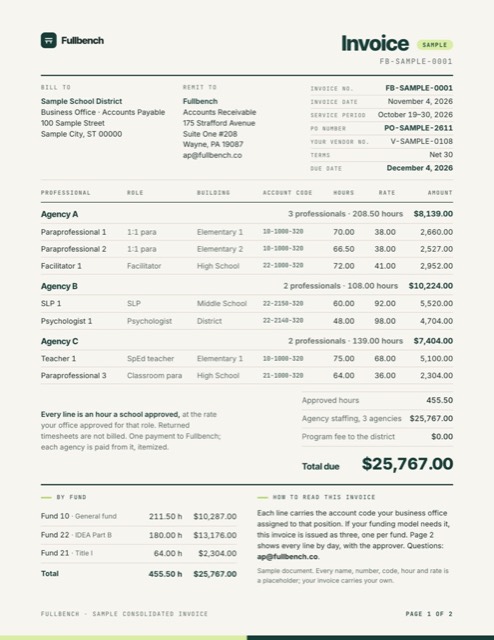
Your business office reads the money. A sample consolidated invoice, the funds-flow summary, and written answers on funding codes, split invoices, payment terms and disputed timesheets. Your agencies' current rates become one rate range per role.
Your solicitor reads the agreement. The participation agreement with its exhibits and a one-page memo written for the file: what the program is, what it costs, what the district keeps. Districts generally treat the coordination as a contracted service rather than a purchase; your solicitor confirms that reading.
Your board approves a contracted service. We prepare the board memo in your board's own format. If your district prefers a cooperative vehicle or a voluntary RFP, we follow that path instead; the procurement page lays out all three.
One rate range per role. We coach every agency to send its best candidates at its best rate inside the range. Your schools get the strongest candidate at the best cost; your agencies compete on equal terms.
If it helps, the person who would run your program joins the call with your business manager and solicitor. The questions and answers become a written FAQ for your team, so nobody repeats the meeting.
Track 1: six steps for your district
Pick the scope. Everything your agencies supply, or one whole program area where you use more than one agency, such as all of special education. The next areas follow on your schedule.
Name the agencies and the rules. The agencies you use today for that scope and the documents each role requires. We consolidate the rates you pay today into one rate range per role for your office to approve.
Name your contacts. One person for the whole district, or one for each department or program that sends requests. Either way, every agency conversation is consolidated with one Fullbench contact.
We seed your workspace. Your buildings, roles, rate ranges and required documents go in before anyone signs in. You review the list; nothing is live until you say so.
We bring your agencies in. We contact every agency you named, explain the terms and the rate ranges, collect their paperwork, and set them up to see your openings. Your staff make no calls. We tell you plainly who signed and who did not.
Your first opening is released. You send the need once. Every approved agency sees it at the same recorded time. Candidates arrive in one list and your office chooses. Fullbench reviews and approves every credential before the start date.
You make four decisions: choose the candidate, approve the start, approve the hours, read the invoice. We do everything in between.
Active placements stay in place through their agreed end date. New openings, extensions, renewals and replacements in the covered scope move through the program after launch.
Track 2: what your agencies hear from us
Clear terms, and equal access to every opening. Agencies ask the same four questions in the same order. Here is what we tell them, so you know the conversation before it happens.
"Why would I do this?"More visibility: every opening in the program, at the same recorded time as every other agency, including roles and buildings it never heard about. More opportunity: it wins on its candidates and its speed, not on who gets the call. A level field: one rate range per role that every agency can staff to.
"What changes for me?" Where the work arrives, and where candidates, documents and timesheets go: one portal instead of an inbox. The agency keeps its brand and its people, and its name stays on every submission. Its rates move into the district's one range for each role.
"Does anyone see my rates?" The district sees the rate on each submission. No agency sees another agency's rates or candidates. Each agency sees the range for the role, its own submissions and its own remittances.
"How do I get paid?" From the district's one payment. Approved, undisputed amounts are remitted within 10 business days after Fullbench receives the district's payment, itemized to the hour, per the agency's participation agreement.
What does not change for the agency: who it employs, how it recruits, and what it pays its people.
If an agency declines: roles in the program are filled through the program, so it stops receiving those openings. Its current placements run to their agreed end date.
Contact with your schools: your district's choice. By default it runs through Fullbench.
Most agencies join once they see what they gain: every opening in the program, one rate range, and itemized payment on a set schedule.
Track 2: an agency's week, before and in the program
Part of the work
Today
In the program
Hearing about an opening
A call or email from the office, when the office gets to it; sometimes only for one role
Every opening in scope, the minute it is released, at the same recorded time as every other approved agency, with the role's rate range attached
Submitting a candidate
A résumé by email, a cover sheet in the agency's own format, a follow-up in 48 hours
One submission in the portal, under the agency's own name, at its best rate inside the range; status visible as it changes; no second agency can submit the same person
Credential files
Sent by email, chased by the office, lost in a thread
Uploaded once per person. Fullbench reviews, approves and tracks every required document. The district reviews nothing and can pull any file from the platform
Timesheets
The agency's own sheet, signed at the school, reconciled by the office later
One clock. The school approves on screen; a returned sheet comes back with a note and is not billed
Invoicing
The agency's own invoice, in its own format, on its own cycle
Approved hours flow onto the district's one invoice automatically; the agency sends nothing
Getting paid
Chasing a business office for status
Remitted from the district's one payment within 10 business days of Fullbench receiving it, itemized to the hour
Contact with your schools
Each agency calls, emails and visits on its own, and follows up with your office on every candidate
Your district's choice. By default it runs through Fullbench, which keeps decisions objective and helps control staffing spend
Rates. One rate range per role, the same for every agency. The district sees the rate on each submission; no agency sees another's.
Level field. Every approved agency starts from the same recorded release and the same rate range. Any tiering exists only if your district asks for it in writing.
What finance will ask
Can the invoice carry our funding codes? Yes. Each position carries the funding or budget code your office assigns, and the invoice shows a subtotal by code. If your funding model needs separate invoices by fund, we split them. Either way it is one point of contact and one record. The sample consolidated invoice shows the format.
One of our agencies bills completely differently from the others. What happens to that? It stops. Every agency's approved hours land on the same itemized invoice in the same format: agency, person, role, site, fund, hours, rate, amount.
How are the rates set? We consolidate what your agencies charge today into one rate range per role, and your office approves it. Every agency works inside that range, and we coach each one to send its best candidates at its best rate.
Who approves the hours? Your schools, on screen, before an hour becomes a line. A returned timesheet goes back to the agency with your note and is not billed.
What are the payment terms? Net 30 on a correct invoice in the standard agreement, and up to net 60 where your board's approval calendar needs it. Disputes are raised within 10 business days; undisputed amounts remain payable.
Is there a program fee or a software fee? No and no. Your district pays for approved hours, at rates inside the range your office approved for each role.
Can we see our own month in this format first? Send a redacted copy of the agency invoice that gives your office the most trouble. We show you that month in the program's format before you decide anything.
What procurement and the board will ask
What are we approving? A contracted service: Fullbench coordinates the agencies your district already uses. Nothing is purchased, so there is no bid. Your solicitor confirms the classification for the file. Where federal funds touch the invoice, federal procurement standards apply; confirm the fund before you choose a path.
Is it exclusive? Yes, for the roles in the program: every agency that fills them works through it. That is what makes one rate range, one record and one invoice possible. Substitute-teacher agreements you already hold stay separate, and active assignments run to their agreed end date.
Does it replace district positions? No. The program runs the agencies that supply people your district does not employ. It does not contract out work your employees do.
Do all agencies compete on equal terms? Yes. Every approved agency receives each opening at the same recorded time and works inside the same rate range. The release record cannot be edited.
What if we leave? You give the notice your agreement states, active placements transition in an orderly way, and you take a complete export of your record. Your agency relationships are direct and continue without us. There is nothing to buy out.
Who gains, and how
Your district. One contract, one invoice and one record for every agency. One rate range per role, so staffing spend is consistent and easy to compare. No program fee, no software fee.
Your schools. Each agency's best candidates at its best rate. Every credential reviewed, approved and tracked by Fullbench before the first day. One contact for every request.
Your agencies. Every opening at the same recorded time, the same rate range as every other agency, and itemized payment on a set schedule. Service wins the work.
Three lawful paths. Direct board approval of a contracted service; cooperative purchasing through a contract another public body competed; or a voluntary RFP when the board wants programs scored side by side. Pick the one your board is comfortable with.
Start with a whole program, and judge it on your own numbers
Begin where more than one agency fills the same roles, such as all of special education. A scorecard built from your own data at 60 to 90 days shows what changed.
Define it before day one.
One whole program area. Every agency-filled role in it, such as all of special education.
Every agency that serves it. More than one, all on the same terms from day one.
A baseline from your recent openings. How the same work runs today.
What the scorecard measures. Who reads it, and the date it is read.
Day 0: scope agreed. One program area, every agency in it. Week one: baseline set, from your recent openings. Day 60 to 90: scorecard read, before and after, from your data. Then add the next area: pupil services, transportation, food service.
Every release, submission, approval and status change is timestamped, so the scorecard shows what happened across all of your agencies.
What the scorecard compares
What the program records
Time to first qualified submission
Release to the first candidate who meets your requirements
Time to cleared start
Release to the first day worked, every credential reviewed and approved
Agencies responding per opening
How many of your agencies answer each opening, and how fast
Rates submitted
Where each agency's rate falls inside the range for the role
Duplicate submissions
The same person sent by more than one agency
Admin touches per opening
Calls, emails and chases today, and the same count in the program
Invoice reconciliation
Time your business office spends verifying hours, rates and codes
Your implementation schedule
Seven points from the first walkthrough to the first invoice. Dates are set with you on the first call; the order is the same in every district.
When
What happens
Who acts
Week 0
Walkthrough with your team and finance, built around one real opening
You, your director, business office; Fullbench
Weeks 1–2
Business office and solicitor review; agency list and current rates shared
Your office; Fullbench answers same day
Board meeting
Participation agreement approved as a contracted service
First opening released to every approved agency at the same recorded time
You send the need; Fullbench releases
First month
Candidate chosen, credentials reviewed and approved by Fullbench, first start, hours approved by your schools
Your office; Fullbench; your schools
Month 2
First consolidated invoice, coded to your funds
Your business office pays once
If the board date moves, every row after it moves with it. Nothing else changes.
Five questions keep both tracks moving. The weekly check-in asks the same five every time:
What got done since last week?
Which approvals, signatures or documents are still open?
Has the board date or the first-opening date moved?
Is anything about an agency or an opening still unsettled?
Who owns the next step, and by when?
Who does what
You decide. Fullbench does the work. Your offices make a short list of decisions. We do the rest, including the review, approval and tracking of every credential and compliance document.
Before launch
Activity
Your district
Fullbench
Each agency
Scope and agencies
HR decides the program areas and the agencies invited
Brings every agency in, collects its paperwork, reports who signed
Signs a participation agreement
Rate range for each role
HR approves one range per role
Consolidates current rates into the range; coaches every agency to its best rate inside it
Works inside the same range as every other agency
Every opening
Activity
Your district
Fullbench
Each agency
The opening
You send the need once
Releases it to every approved agency at the same recorded time
Sends its best candidates at its best rate
The candidate
You choose from one list
Passes your decision to every agency and records it
Submits under its own name
Credentials and compliance
Nothing to review. Pull any file from the platform, any time
Reviews, approves and tracks every required document. No start date until the file is complete
Uploads each file once per person
Hours
Schools approve on screen
Turns approved hours into the invoice
Corrects a returned sheet
Invoice and payment
Business office pays one invoice, on the funding codes it assigns
One itemized invoice, coded to your funds; split by fund if asked
Paid within 10 business days after Fullbench receives the district's payment
Each agency employs, recruits and pays its own people. Fullbench administers the program.
One contract. One participation agreement covers every agency in your program. Substitute-teacher agreements stay separate.
One invoice. Every agency's approved hours on one itemized invoice, inside the rate ranges you approved. One payment.
One contact. Every staffing request goes to one Fullbench contact who answers, chases, and closes it.
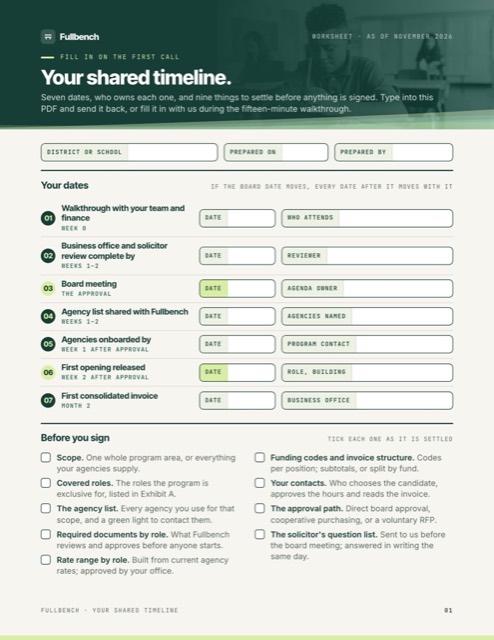
Worksheet 1: your dates, and the people who hold them
We fill these in with you on the first call. The PDF has the form.
Walkthrough with your team and finance: date, who attends
Business office and solicitor review complete by: date, reviewer
Board meeting: date, agenda owner
Agency list shared with Fullbench: date, agencies named
Agencies onboarded by: date, your program contact
First opening released: date, role and building
First consolidated invoice: date, business office contact
One name for each seat, with a backup and a phone or email:
Executive sponsor
HR lead for the transition
Business office lead
Solicitor
School-level hour approver
Your Fullbench contact
Worksheet 2: before you sign
Five things, most of which your office has already decided.
Where to start. Everything your agencies supply, or one whole program area where you use more than one agency.
The agency list. Every agency you use there, and a green light for us to contact them.
Rate range for each role. We draft the ranges from the rates you pay today; your office approves them.
Your contacts. One for the district, or one for each department or program.
The approval path. Direct board approval, cooperative purchasing, or a voluntary RFP.
Worksheet 2: your first opening
Five things in place the day it is released. We set up each one with you.
Role, school and need. The position, the building or department, and how many.
Rate range and funding code. Attached to the opening when it is released.
What the role requires. The documents Fullbench reviews and approves before anyone starts.
Who chooses, and who approves hours. The person who picks the candidate, and the approver at the school.
Sample invoice seen. Your business office knows the format its invoice will take.
Everything else is our work: contacting every agency and bringing it into the program; collecting agreements, insurance and paperwork; reviewing, approving and tracking every credential; releasing each opening and following up with every agency; building one invoice from approved hours.
On the first call we fill in both worksheets with you, around one real opening. Anything still open goes on the weekly check-in list.
Take How the Transition Works with you
14 pages · about 10 min, formatted to print and forward to your cabinet or board.
Each part of your agency staffing, from openings, rates and communication to credentials and the invoice: how it runs today, what that costs your team, and what changes when Fullbench takes it over.
The invoice a business office receives: every agency's approved hours on one bill, with your purchase order number, an account code on every line, a subtotal by fund, and the timesheet backup attached.
A one-page form your district can type straight into: seven dates from the walkthrough to the first invoice, the person who owns each one, and the nine things to settle before you sign.
Fifteen minutes on your roles, the rates you pay today and the agencies you already use, with the program open. No slides, no obligation, and no cost to your district.
Candidate review, document approval and billing, on a case like yours.
Where to start: everything your agencies supply, or one whole program area such as all of special education.
You leave with a clear next step. Nothing is signed on the call.
Talk to us
Pick a 15-minute slot. The invite lands in your inbox before you close this.
Times show in your own timezone; we are in Eastern. If the calendar does not load on your district network, open it in a new tab or call (484) 482-8223.
Your request is in.
A person replies the same business day, before 5pm ET, with two or three 15-minute slots. Here is the one-page version to forward to whoever else should be on the call.
What happens next
You pick a slot, and the invitation follows by email.
On the call we open the platform on your roles and the agencies you already use.
If it fits, we start with one whole program area. Nothing is signed on the call.