Fullbench

For the business office

Approved without a new purchase order.

Every district has its own route for a contracted service. We help you identify which one fits, then prepare the packet your board and business office need. Here are the three paths Pennsylvania districts use, the two questions to settle with your solicitor first, and what we send for the file.

  • $0 to the district
  • No purchase order
  • One agreement
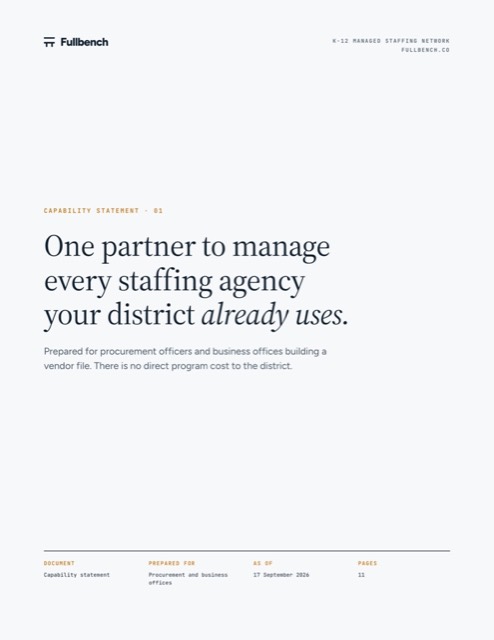
First page of the Fullbench capability statement
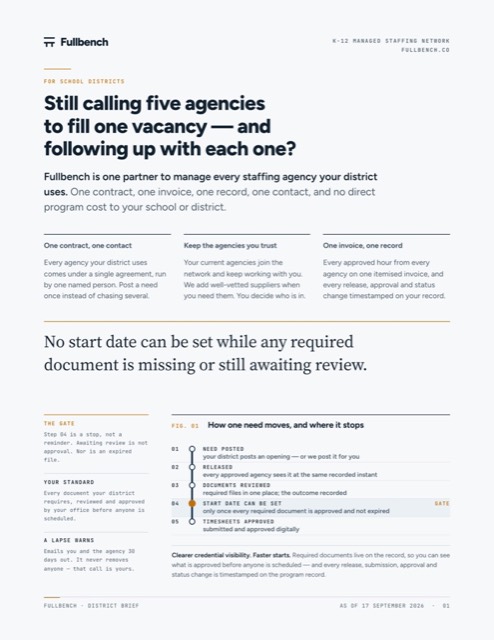
First page of the Fullbench district one-pager
The two documents a vendor file starts with. Both open without a form.

Start here

Start by confirming which route applies.

Your district keeps paying the agencies it already uses, for the hours your own schools approved, at the rates you approved. Fullbench adds no program fee and no license, so there is no separate purchase to fund. Districts generally treat the coordination as a contracted service rather than a purchase of supplies or construction, and that reading is your solicitor's to confirm in a short memo for the file. We prepare the agreement, the exhibits and a board memo; we do not give legal advice.

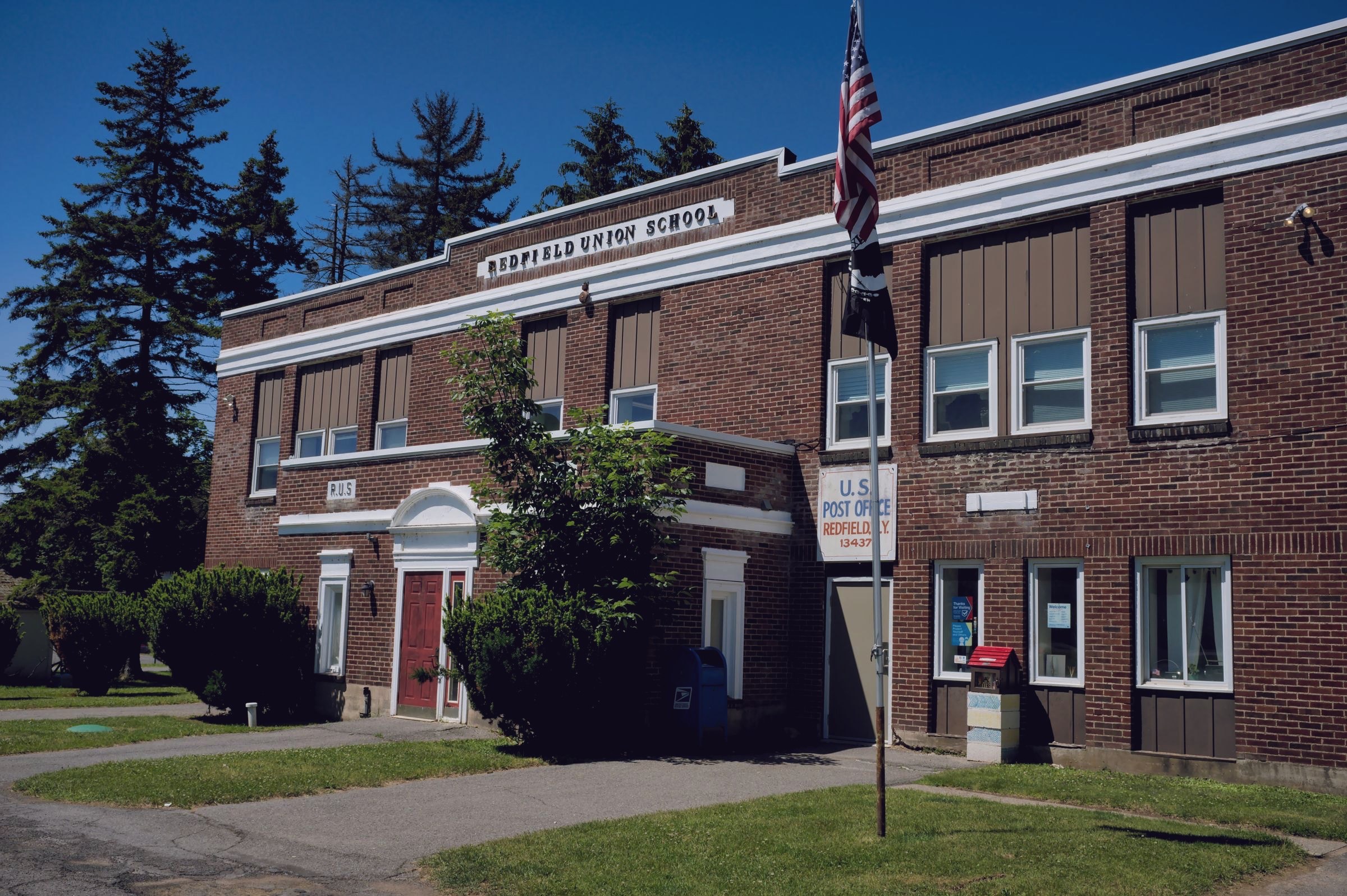
A brick district school building with an American flag out front.
The board approves a contracted service. Nothing is purchased, so nothing is bid.

Written for Pennsylvania. The same three paths exist in most states under different section numbers; if you are elsewhere, send us your state and we will send the citations we have.

Three lawful paths

Pick the one your board is comfortable with.

Path 1

Direct board approval

The board approves the participation agreement as a contracted service. Under 24 P.S. § 5-508 that is a recorded roll-call majority of all members for any contract over the statutory threshold. No procurement calendar to run.

We send the agreement, its exhibits, and a one-page board memo written for the packet.

Use it when you want to start this term and your solicitor is comfortable with the contracted-service reading.

Ask counsel to confirm the classification and the threshold that applies to your district.

Path 2

Cooperative purchasing

Pennsylvania's Procurement Code, 62 Pa.C.S. § 1902, expressly lets a district buy services through a cooperative contract another public body competed. The competition happened elsewhere, it is documented, and the pricing was benchmarked.

Ask us which cooperative vehicles currently list managed staffing; we will tell you plainly which ones we hold and which we do not.

Use it when the board wants a competed record behind the award without running its own.

Path 3

A voluntary RFP

You can always run one the law does not require, and some boards prefer the structured comparison. The one rule: once you publish an RFP you must follow your own rules to the end (the Lasday principle), so write it to compare what you actually care about.

We respond to RFPs. We will also tell you if we think one is unnecessary for your situation.

Use it when several programs are in the market and the board wants them scored side by side.

Two things to check first

Who is paying, and whose work is it.

  • Federal funds. If Title I, IDEA, or relief money touches the invoice, the federal procurement standards in 2 CFR 200.320 and your district's Policy 626 apply regardless of state exemptions. Most districts pay agency invoices from general fund; confirm which fund before you choose a path.
  • Outsourcing your own employees' work. Under 24 P.S. § 5-528, contracting work currently done by district employees to a for-profit third party carries notice and hearing steps. Fullbench runs the agencies that supply people your district does not employ; it does not replace district positions. Say so in the memo.

What the packet contains

  • The participation agreement with Exhibit A, where your district selects exclusive, preferred, or non-exclusive.
  • A one-page board memo in the board's own format: what it is, what it costs, what the district keeps.
  • The capability statement, written for the vendor file.
  • Written answers to your data-privacy addendum and security questionnaire, the same business day.

Open the capability statement →

From yes to first opening

What the calendar looks like after the board says yes.

Day 0

Board approval

The agreement is signed. Nothing is purchased and no purchase order is raised.

Week 1

Setup, on our side

Your buildings, roles, ceiling rates, and required documents go in. We onboard the agencies you named.

Week 2

First opening released

Your first need goes to every approved agency at the same recorded time.

Month 2

First invoice

One invoice for every agency, at the rates you approved, from hours your schools signed off.

Questions

Common questions

If it is free to the district, how does Fullbench get paid?

By the agencies that participate in it, and only after your district has paid. In order: your schools approve the hours; you receive one consolidated invoice at the bill rates your office approved and pay it; we remit each participating agency its share out of that payment; and the participation fee is deducted from that remittance. So the program is funded on the agency’s side of the invoice, out of what the agency billed — never added to a rate your district approved, never billed to the district, and never deducted from anybody before your payment has been collected. What each agency agrees to is a term of the participation agreement it signs with us; it is not a district term, and it cannot change what your district owes. The sequence is laid out step by step on what it costs your district.

What does it take to start?

Three things from you: your agency list, your rate ceilings, and the document types you require before someone works in a building. Most districts are posting within a week. Your agencies do their own setup — we onboard each one directly, and none of that work lands on your staff.

What does implementation take?

You send us four things first: the roles you fill through agencies, the agencies you use, the documents you require before anyone starts, and who approves candidates and hours. We build the workspace from that, so your team reviews instead of builds. Then one onboarding call of about an hour confirms it, along with your ceiling rates. In week one we onboard the agencies you named — outreach and a participation agreement with each — and your first opening usually goes out in week two, to whichever agencies have signed by then. There is no purchase order, nothing to install and no data migration.

What happens if we leave?

Your agencies were always yours: you keep the ones you use, add or drop any of them at any time, and your data leaves with you. The agreement puts every commercial term on the page before you sign it.

All questions

Next step

Fifteen minutes with the person who would run it, and the packet in your inbox afterwards.