One release, every agency
Your opening reaches every approved agency the same minute. The whole bench works it, not one agency at a time, and every agency is measured from the same release.
Vendor management, defined
A vendor management system (VMS) for school districts puts every staffing agency you use through one process: one release, one credential standard, one clock, one invoice. Fullbench is that system, built only for K-12, and our team runs it for you. Your district keeps its agencies, its rates, and every hiring decision, at no cost.
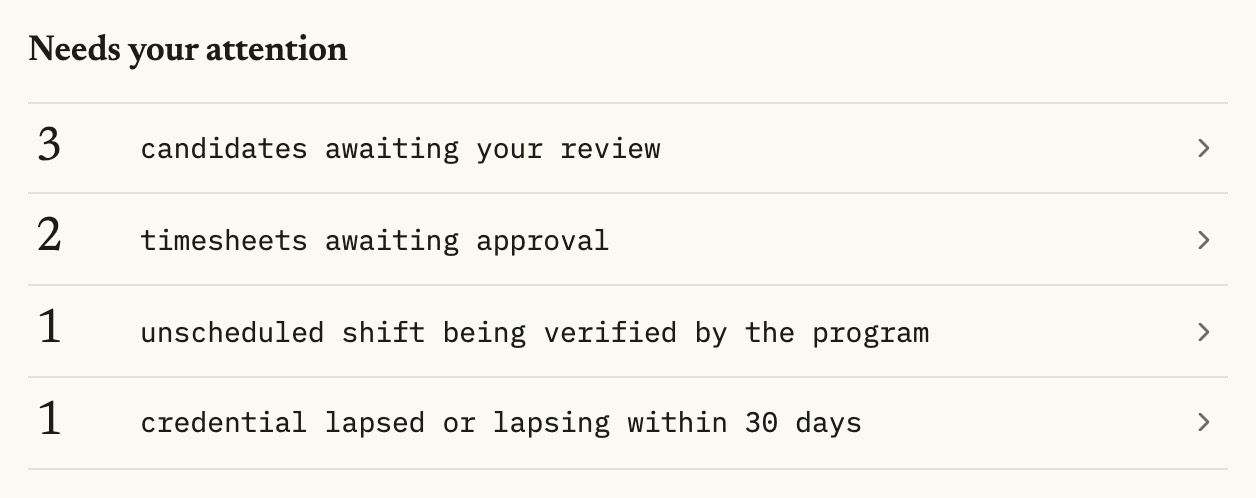
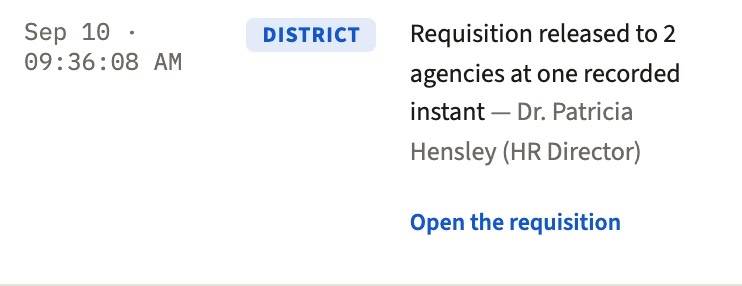
A vendor management system for school districts is software that runs one shared process across every staffing agency a district uses. Openings are posted once and released to all approved agencies, candidate submissions and credential documents move through one record, hours are captured on one clock, and every agency's billing consolidates into one invoice. The district keeps its own agencies, its own negotiated rates, and its own hiring decisions.
An education managed service provider (MSP) is a team that runs a district's staffing-agency program on the district's behalf: onboarding agencies, releasing openings, administering credential and billing rules, and serving as the district's one point of contact. The VMS is the software; the MSP is the team that runs it. Fullbench is both, and in K-12 the district is charged nothing because the program is funded by the participating agencies.
No. Frontline Absence & Time, Aesop, Red Rover and their equivalents fill a class when one of your own employees is out. A staffing VMS manages the outside agencies that supply people your district does not employ: long-term substitutes, paraprofessionals, related-services providers, nurses. Districts run both, and Fullbench does not ask you to change the one your building secretaries already know.
Why districts adopt one
Special education brings the first agency, related services a second, nursing a third, substitutes a fourth. Each arrives with its own contract, rate card, credential packet, and invoice cycle, and the openings that hurt most are the ones that sit while your office works them one supplier at a time.
Your opening reaches every approved agency the same minute. The whole bench works it, not one agency at a time, and every agency is measured from the same release.
Agencies upload each document; your office approves them item by item. Nobody starts in a building on a file your office has not approved, because the start date is held until it has.
Everyone placed through the program clocks in on one system. Your schools approve the hours, and only approved hours reach the one invoice your business office pays.
What makes Fullbench different
Compare Fullbench to other programs → What it costs your district →
Keep reading
Plain-language explainers for the questions every district asks before adopting a vendor management system: what a VMS does, step by step · how the economics work and where the money comes from · why fairness between agencies needs a timestamp · why credential gates beat credential policies.
Questions
No — retention is the design. Your approved agencies keep supplying the same people under their own brands and rates; what changes is the shared workflow and record. Districts can introduce agencies they already trust.
Nothing — no software fee, no licences, no implementation charge, and no purchase order to raise. The program is funded by the agencies that participate in it. The order is what matters: your schools approve the hours, your district pays one consolidated invoice at the bill rates your own office approved, we remit each agency its share out of that payment, and the participation fee is deducted from the agency’s remittance. It happens on the agency’s side of the line and only after your payment has been collected, so nothing the program earns is ever added to a rate your district approved or taken out of district funds.
Agencies price the fee like any cost of doing business — the counterweight is that every opening is competed by multiple agencies under a maximum bill rate your office sets and can lower on any posting, with every submitted rate visible side by side. An agency that pads gets undercut. Compare winning rates to what you pay those same agencies today; that's the real test.
Next step
Fifteen minutes on your roles, your rate ceilings and the agencies you already use, with the program open. No slides, no obligation, and no cost to your district.
What we cover
You leave with a clear next step. Nothing is signed on the call.
Pick a 15-minute slot. The invite lands in your inbox before you close this.
Times show in your own timezone; we are in Eastern. If the calendar does not load on your district network, open it in a new tab or call (484) 482-8223.
A person replies the same business day, before 5pm ET, with two or three 15-minute slots. Here is the one-page version to forward to whoever else should be on the call.
Prefer to call? (484) 482-8223, weekdays 8 to 5 ET.