Fullbench vs Q360
Both free to districts. Who actually competes for your openings, and whether the operator's own staffing affiliate plays by the same rules.
Compare · Frontline Education
Frontline Absence Management fills a class when one of your own employees is out, from your own substitute pool. Your agencies still arrive one at a time, each with its own contract, clearances and invoice. Fullbench™ is the K-12 managed staffing provider (MSP) that runs every agency as one program, with no program fee, beside the Frontline system you keep.
Side by side
Frontline is built around the people your district employs. Fullbench is built around the people your agencies supply: agency substitutes, long-term subs, paraprofessionals, related-services providers and nurses. Here is what each one puts on your office’s desk.
| Question | Fullbench | Frontline Absence Management + your agencies (per Frontline’s published materials) |
|---|---|---|
| What it is | A K-12 managed staffing provider (MSP) with its own VMS: our team runs every staffing agency your district uses as one program. | K-12 absence and time management software to “track absences, place the right substitute fast, and ensure payroll is correct the first time.” |
| Whose people it covers | The people your district does not employ: every agency’s substitutes, long-term subs, paraprofessionals, related-services providers and nurses. | Your employees and your substitute pool. Absences are matched to substitutes using “skill settings, certifications, preference and exclusion lists.” |
| Who does the work every day | Our team: agency onboarding, every release, the chasing, the document follow-up, billing and remittances. Your office makes the decisions. | Your staff, in the software. Jobs fill when substitutes accept online or in the app, when automated calls reach eligible substitutes, or when an administrator assigns one. |
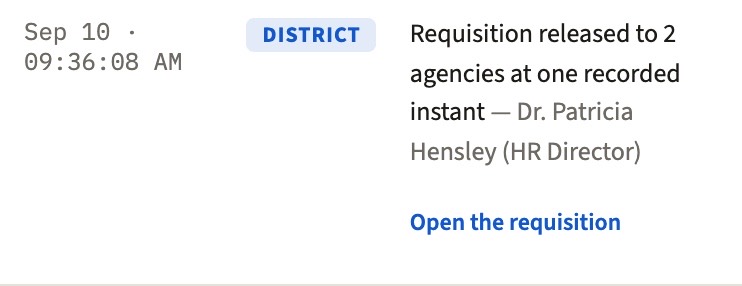
| How your agencies fit in | One participation agreement covers every agency. Each opening reaches every approved agency at the same recorded instant, and every agency is measured from that instant on one scorecard. | Its partner directory lists substitute-placement companies that integrate with Absence & Time. A service that runs a district’s agencies as one program was not located in its public materials as of October 2026. |
| What stops an uncleared start | Fullbench reviews, approves and tracks each agency worker’s required documents for your district. No start date can be set while anything is missing, unreviewed or expired. | Matches substitutes on the skills and certifications set up in the system. A rule holding an agency worker’s start date until your office approves the file was not located as of October 2026. |
| How agency staff are billed | One itemized invoice for every agency, built from hours your schools approved, at the rates your office approved. | Syncs time and leave to payroll for your employees. Consolidated billing for outside agencies was not described in the pages reviewed as of October 2026. |
| What it costs | No program fee to the district: no software fee, no per-seat fee, no implementation charge. | A subscription “based on the number of employees on the system,” by its substitute management FAQ. |
Based on publicly available information as of October 2026: Frontline’s Absence & Time page, its substitute management page and FAQ, its page on the Aesop rename, and its partner directory, listed with links below. “Not located” and “not described” refer to those public materials, not to Frontline’s internal practices. Frontline and Aesop are trademarks of their owner. Spot an error? Tell us and we will correct it.
The takeaway
Questions
No. Frontline keeps filling absences for your own employees from your substitute pool. Fullbench is the K-12 managed staffing provider (MSP) that runs the outside agencies supplying the people you do not employ: agency substitutes, long-term subs, paraprofessionals, related-services providers and nurses. Nothing your building secretaries do in Frontline changes.
Frontline’s partner directory lists substitute-placement companies that integrate with Absence & Time. A service that puts every agency under one agreement, holds each start date until the file is reviewed and approved, and consolidates the agencies’ invoices was not located in its public materials as of October 2026. That is the program Fullbench runs.
Fullbench. Every opening reaches every approved agency at the same recorded instant, our team chases the submissions and the no-shows, we review and approve every document before anyone starts, and your business office pays one invoice for every agency, with no program fee.
Frontline describes its absence management subscription as based on the number of employees on the system. Fullbench charges the district no program fee: no software fee, no per-seat fee and no implementation charge. You pay one invoice for hours your schools approved, at rates inside the range your office approved for each role.
Yes. Frontline keeps covering your employees’ absences, and Fullbench runs the agencies. There is nothing for your staff to install or configure: you submit each opening once, the agencies you name are onboarded in week one, and your first opening usually goes out in week two.
Comparison last verified 19 October 2026 against Frontline Education's own published materials.
Sources
Checked 19 October 2026. We compare only against what the other program publishes about itself — never against what a salesperson told us.
If anything here is out of date or wrong, tell us at hello@fullbench.co and we will correct it. Frontline Education is a trademark of its owner; this page exists for factual comparison.
Other comparisons
Both free to districts. Who actually competes for your openings, and whether the operator's own staffing affiliate plays by the same rules.
An Amergis-scale, cross-sector MSP versus an education-only program with published economics.
Licensed VMS software your staff operate versus an operated program. Who runs the workflow, and what it costs the district.
One company's bench at a negotiated markup, or every agency you approve working inside one rate range your office approved.
A single-employer program at a negotiated markup, versus many agencies competing on one release log — and what each lets a district check afterwards.
Two education MSPs at no direct cost to the district. What differs: who sees each opening and when, who sets the rate, and who approves the file before day one.
VMS software from Amergis that a district's staff run, or a K-12 MSP that runs every agency for you on its own VMS.
Two education MSPs at no direct cost to the district. What differs: who curates the agencies, who sets the rate, and who approves the file.
Neither charges the district. What differs: an order of preference versus one release to every agency, and who approves the file.
VMS software licensed by staffing agencies and MSPs, or a program a district joins directly with no program fee.
An enterprise VMS your HR and procurement teams operate, or a K-12 MSP that runs every agency for you with no program fee.
A contingent workforce system a program team configures, or a K-12 MSP and VMS that runs every agency for your district.
One substitute marketplace, or every substitute and paraprofessional agency you keep run as one program, with one invoice and no program fee.
One staffing agency that recruits and runs payroll for its own staff, or every agency you keep run as one program.
Source4Teachers now forwards to ESS: one substitute employer, or every agency you choose run as one program.
BlueSky is the software a staffing provider runs its school program on; Fullbench is the program and the software, answering to the district.
Aya Education fills from its own national network plus partners, on LotusOne; Fullbench releases every opening to all your agencies at one instant.
StaffBridge is K-12 VMS software, and says it is software only; Fullbench is the team that runs the program plus the VMS it runs on.
All comparisons, and what VMS, MSP and master vendor actually mean
Next step
Fifteen minutes on your roles, the rates you pay today and the agencies you already use, with the program open. No slides, no obligation, and no cost to your district.
What we cover
You leave with a clear next step. Nothing is signed on the call.
Pick a 15-minute slot. The invite lands in your inbox before you close this.
Times show in your own timezone; we are in Eastern. If the calendar does not load on your district network, open it in a new tab or use the contact form.
A person replies the same business day, before 5pm ET, with two or three 15-minute slots. Here is the one-page version to forward to whoever else should be on the call.
Prefer to write? Use the contact form; a person replies the same business day.