FAQ
The questions districts and agencies actually ask
Straight answers to what districts and agencies ask before they sign: what changes, what does not, who decides, and what it costs.
Questions
The questions districts actually ask
Does this replace our current agencies?
No — retention is the design. Your approved agencies keep supplying the same people under their own brands and rates; what changes is the shared workflow and record. Districts can introduce agencies they already trust.
What does it cost the district?
Nothing — no software fee, no licences, no implementation charge, and no purchase order to raise. The program is funded by the agencies that participate in it. The order is what matters: your schools approve the hours, your district pays one consolidated invoice at the bill rates your own office approved, we remit each agency its share out of that payment, and the participation fee is deducted from the agency’s remittance. It happens on the agency’s side of the line and only after your payment has been collected, so nothing the program earns is ever added to a rate your district approved or taken out of district funds.
How is fairness between agencies enforced?
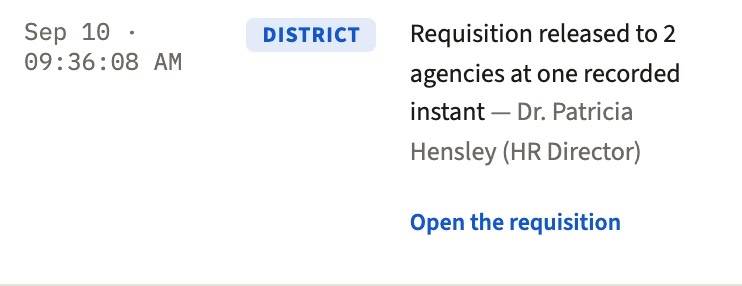
It's recorded, not promised: one recorded release instant for every agency, district-driven statuses (agencies can't advance their own candidates), credential gates — and a timestamp with a name on every release, submission, and credential decision.
Won't agencies raise rates to cover the fee?
Agencies price the fee like any cost of doing business — the counterweight is that every opening is competed by multiple agencies under a maximum bill rate your office sets and can lower on any posting, with every submitted rate visible side by side. An agency that pads gets undercut. Compare winning rates to what you pay those same agencies today; that's the real test.
Do we have to replace our ERP or payroll?
No. Fullbench runs the staffing loop — the request, the candidates, the credential file, the hours and the invoice — alongside the systems you already have. Nothing to install, nothing to migrate, and your program record exports in full whenever you ask.
What happens if we leave?
Your agencies were always yours: you keep the ones you use, add or drop any of them at any time, and your data leaves with you. The agreement puts every commercial term on the page before you sign it.
Who employs the worker — and who carries the liability?
The agency stays responsible for engaging the person it supplies, on the basis it uses today: payroll and employment obligations for the people it employs, or its own contract terms where a related-services professional works that way. Coordinating the work through Fullbench does not change it. The district supervises the work; the platform administers the workflow between them. Nothing about your co-employment posture changes.
What if an agency we use will not join?
It happens, and you are not forced to choose. We approach the agencies you name, explain the terms, and tell you plainly who signed and who did not. An agency that declines keeps working with you exactly as it does today, outside the program: you contact them directly and pay their invoice separately, and everything we coordinate stays inside the program. Most agencies join once they see they keep their own rates, their own people and their own brand, and that they are paid on collection.
How do agencies get into the program?
Districts introduce the agencies they already work with — you can request an agency from inside the platform and watch its onboarding status the whole way. Agencies are vetted before they see any work: insurance, credential standards, references.
Is Fullbench a VMS or an MSP?
Both — and in practice districts use the terms interchangeably. The VMS is the software: requisitions, timestamped releases, credential gates, consolidated invoicing, scorecards. The MSP is the managed program that runs on it: Fullbench operates the network, vets and onboards agencies, and administers the workflow end to end. You get one accountable program; the software is how its rules are enforced and recorded.
What stays with the district?
Every decision. Your agencies employ the professionals; your office chooses every candidate, sets every rate ceiling, approves every file and every hour, and keeps its own HR, background-check and board-approval processes exactly as they are. Fullbench runs the coordination between those decisions: every opening to every approved agency at one recorded instant, every required document collected and put in front of you before a start date can exist, and every approved hour on one invoice.
What does implementation take?
You send us four things first: the roles you fill through agencies, the agencies you use, the documents you require before anyone starts, and who approves candidates and hours. We build the workspace from that, so your team reviews instead of builds. Then one onboarding call of about an hour confirms it, along with your ceiling rates. In week one we onboard the agencies you named — outreach and a participation agreement with each — and your first opening usually goes out in week two, to whichever agencies have signed by then. There is no purchase order, nothing to install and no data migration.
What do our schools do differently day to day?
Less, mostly. A school raises a need once, to one contact, instead of separately contacting and following up with several agencies. Timesheets are reviewed and approved digitally, and credential status is visible before a start date can exist. That is the whole change on day one.
Who do we call when something looks wrong?
One person: your Fullbench program contact. That is the point of one partner — one call, not five. And because every release, submission, approval and status change is timestamped on the program record, “what happened here?” has a factual answer, fast. You can also reach us any time through fullbench.co/support.
Is our data ours?
Yes. Your placements, timesheets, approvals and the full timestamped program record belong to your district. You can request an export at any time — not just on the way out.
Can we control distribution ourselves?
Yes. The program is managed for you by default, but your team can release openings itself any time you want the wheel. Either way, every approved agency sees an opening at the same recorded instant — no favorites, no phone tree.
What happens when a clearance expires mid-year?
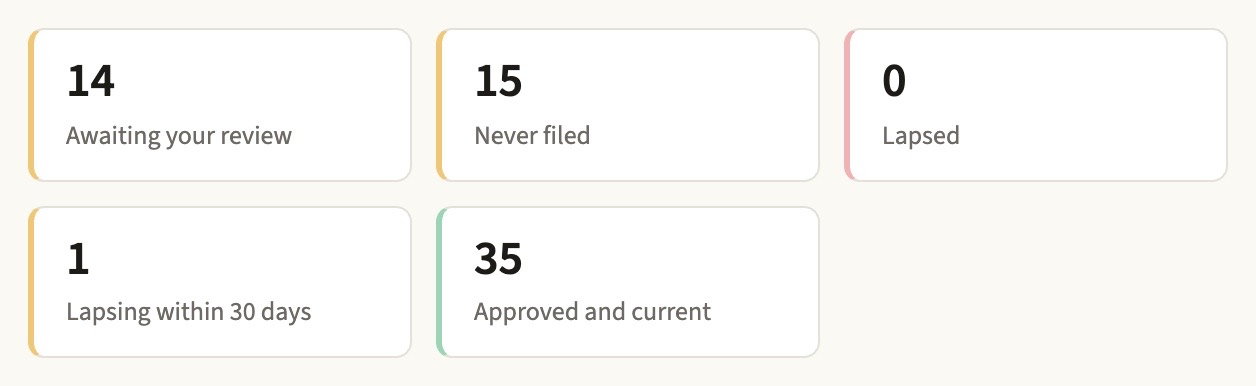
Expiry is enforced by the same rule as the gate: once a document passes its expiry date it stops satisfying the requirement, so no new start date can be set against it. For people already working, a daily check re-asks the gate's question of every active placement and emails you 30 days before a clearance lapses — the district hears about its own workers, the agency about its own. It warns; it never pulls someone from a building on its own. That decision stays yours.
Do we replace the system we use for daily subs?
No. Fullbench manages your agency-supplied staff — postings, credentials, time, and invoicing across every agency you use. Your internal absence-management and sub-placement system keeps doing exactly what it does today for your own employees. Nothing about Frontline, Aesop, Red Rover, or a building secretary’s call list changes.
What does it take to start?
Three things from you: your agency list, your rate ceilings, and the document types you require before someone works in a building. Most districts are posting within a week. Your agencies do their own setup — we onboard each one directly, and none of that work lands on your staff.
How does consolidated invoicing work across multiple staffing agencies?
Every agency’s approved hours become one invoice. Workers clock in and out on the platform, your schools approve the time, and approved hours from every participating agency consolidate into a single itemized invoice per period — instead of separate bills in separate formats on separate cycles. Each line traces back to a placement, a rate you set, and school-approved hours, so your business office reconciles one document rather than five. The agency participation fee is deducted from each agency’s remittance after your district has paid; it is never added to the rate you approved.
Is Fullbench vendor-neutral?
Neutral in a way your office can check, not one you have to take on faith. Every approved agency receives the same opening at the same recorded instant, so no agency gets a head start, and every agency is scored in the same scorecards from that same instant. Fullbench does not employ the workers — your agencies do. Fullbench checks each submission against your own required list — every document present, in date and legible, anyone missing one held back. Your own team makes every hiring decision; no agency can advance its own candidate, and the release timestamp, with a name attached, is the record you can audit. The team that runs this program also participates in the program as a staffing agency, and it competes under exactly the same rules as every other agency: the same release instant, the same scorecard, no view of any other agency’s candidates or rates, and your district’s final say on every candidate.
How does Fullbench handle credential compliance?
Compliance is a gate on the start date, not a reminder after the fact. Agencies upload each candidate’s documents — background checks, fingerprint clearances, licensure — and your office approves them item by item. The software cannot set a start date while anything is missing or awaiting review, and never against a document past its expiry. For people already working, a daily check re-asks that question and emails the district and the agency 30 days before a clearance lapses. The gate enforces the documents your district requires, each reviewed and approved by your office.
We are one charter school, not a district. Are we too small for this?
No. The program fits a single school as naturally as a district. It is scoped to your school: one address, one approval chain, one invoice, and one seat that can approve both candidates and hours if that is how your school is staffed. Nothing in it assumes a central office, and it costs your school nothing. If you run several campuses under one board, each campus is set up as its own site under one agreement and one invoice. There is a page for this: Fullbench for charter schools.
Who in our district actually sends you a staffing request?
Whoever raises the need today. In most districts that is three people. Human resources sends the openings across the buildings, the ceiling rate on each one, and the list of agencies approved to see them. Special education or student services sends the related-services and 1:1 seats an IEP is waiting on. A principal or school leader sends the seat in their own building. All three send it to the same Fullbench contact — a call, a message, or a line typed into the platform, whichever is fastest for them — and we take it from there: release it to your approved agencies, chase the submissions, collect the documents your office requires, and follow the person through onboarding. There is no per-seat charge for adding people who can send requests, because there is no charge to the district at all.
If it is free to the district, how does Fullbench get paid?
By the agencies that participate in it, and only after your district has paid. In order: your schools approve the hours; you receive one consolidated invoice at the bill rates your office approved and pay it; we remit each participating agency its share out of that payment; and the participation fee is deducted from that remittance. So the program is funded on the agency’s side of the invoice, out of what the agency billed — never added to a rate your district approved, never billed to the district, and never deducted from anybody before your payment has been collected. What each agency agrees to is a term of the participation agreement it signs with us; it is not a district term, and it cannot change what your district owes. The sequence is laid out step by step on what it costs your district.
What does Fullbench manage?
The coordination between your district and its participating staffing agencies. You send a staffing need once; Fullbench releases it to every approved agency at one recorded time, follows up on submissions and interview times, collects each required document, and turns the hours your schools approve into one itemized invoice. Your office keeps the decisions: which agencies participate, which candidate is chosen, which documents are approved, and which hours are paid.
Who selects candidates and approves credentials?
Your district, every time. Agencies submit candidates; your office interviews, chooses, and sets the start date. Agencies upload each required document; your office approves it. No agency can advance its own candidate, and no start date can be set while a required document is missing or still awaiting your review. Every decision carries a name and a time on the program record.
Still holding a question this page did not answer? Ask it live, on your own district’s roles.
Book your 15 minutesNext step
Talk to the person who would run your program.
Fifteen minutes on your roles, your rate ceilings and the agencies you already use, with the program open. No slides, no obligation, and no cost to your district.
What we cover
- How your district manages its agencies today.
- Candidate review, document approval and billing, on a case like yours.
- Whether one department is the right place to start.
You leave with a clear next step. Nothing is signed on the call.