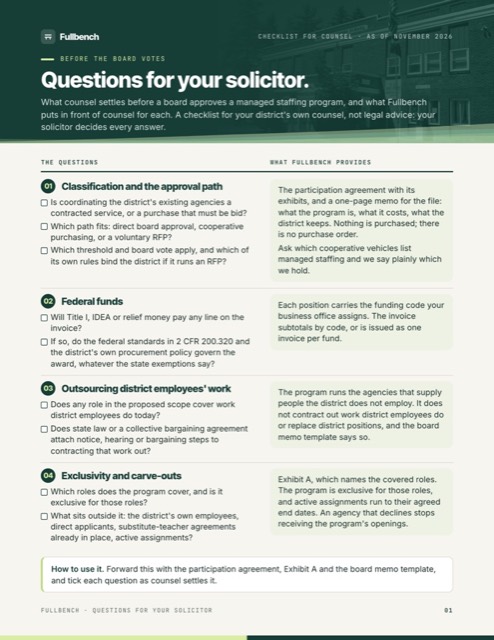
The questions counsel settles before a board approves a managed staffing program, grouped from classification to who employs the professional, with what Fullbench™ provides for each.
2 pages · about 3 min · for district solicitors and the business managers who brief them
1. Classification and the approval path
The questions. Is coordinating the district's existing agencies a contracted service, or a purchase that must be bid? Which path fits: direct board approval, cooperative purchasing, or a voluntary RFP? Which threshold and board vote apply, and which of its own rules bind the district if it runs an RFP?
What Fullbench provides. The participation agreement with its exhibits, and a one-page memo for the file: what the program is, what it costs, what the district keeps. Nothing is purchased and there is no purchase order. Ask which cooperative vehicles list managed staffing and we say plainly which we hold. The procurement page describes all three paths.
2. Federal funds
The questions. Will Title I, IDEA or relief money pay any line on the invoice? If so, do the federal procurement standards in 2 CFR 200.320 and the district's own procurement policy govern the award, whatever the state exemptions say?
What Fullbench provides. Each position carries the funding code your business office assigns. The invoice subtotals by code, or is issued as one invoice per fund. Confirm the fund before you choose a path.
3. Outsourcing district employees' work
The questions. Does any role in the proposed scope cover work district employees do today? Does state law or a collective bargaining agreement attach notice, hearing or bargaining steps to contracting that work out?
What Fullbench provides. The program runs the agencies that supply people the district does not employ. It does not contract out work district employees do or replace district positions, and the board memo template says so.
4. Exclusivity and carve-outs
The questions. Which roles does the program cover, and is it exclusive for those roles? What sits outside it: the district's own employees, direct applicants, substitute-teacher agreements already in place, active assignments?
What Fullbench provides. Exhibit A, which names the covered roles. The program is exclusive for those roles, and active assignments run to their agreed end dates. An agency that declines stops receiving the program's openings. Any tiering of agencies exists only if the district asks for it in writing.
5. Data privacy and security
The questions. Which data-privacy addendum and security questionnaire apply? What data does the program hold, where, and who can see it? What are the breach-notice, retention and deletion terms?
What Fullbench provides. Written answers to every line before anyone signs. No student data of any kind: the program holds adult workforce records only. US region, encrypted in transit and at rest, access scoped by district. Incidents are reported to your named contact within 72 hours, and on written request district data is deleted within 30 days of termination, except records kept for tax and payroll. The security page has the detail.
6. Insurance certificates
The questions. Which coverages and limits does the district require of an agency that places people in its buildings? Must the district be named as certificate holder or additional insured, and in what wording?
What Fullbench provides. Agencies are vetted before they see any work, insurance included. Name the coverages and wording your district requires and we collect the certificates from each agency during onboarding, with the rest of its paperwork.
7. Termination, notice and active placements
The questions. What notice ends the agreement, and is the term acceptable? What happens to active placements at launch and at exit, and what record does the district keep?
What Fullbench provides. At launch, active placements stay in place through their agreed end date. At exit, the district gives the notice its agreement states, active placements transition in an orderly way, and the district takes a complete export of its record: placements, timesheets, approvals, credential statuses. Agency relationships are direct and continue without us.
8. Payment terms and disputes
The questions. Do the payment terms and the dispute window fit the district's bill-paying calendar? Who approves hours, and is anything added to the rates the district approved?
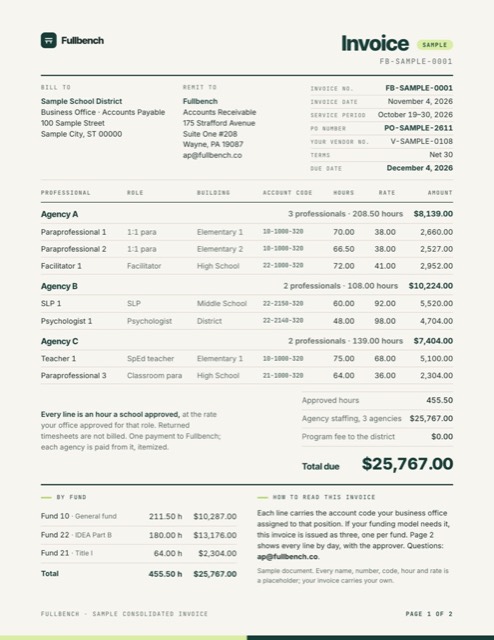
What Fullbench provides. Net 30 on a correct invoice in the standard agreement, and up to net 60 where the board's approval calendar needs it; disputes raised within 10 business days; undisputed amounts remain payable. Schools approve hours on screen before they become an invoice line. No program fee: the district pays approved hours at approved rates, on one invoice. The sample invoice shows the format.
9. Who employs the professional
The questions. Who is the employer of each person placed, for wages, taxes and employment matters? What are the terms if the district hires a placed professional directly?
What Fullbench provides. The agency employs the professional; Fullbench administers the program. The district chooses each candidate; Fullbench reviews and approves each credential file. Direct-hire terms are written into the participation agreement for counsel to read.
How to use it
Forward the list with the participation agreement, Exhibit A and the board memo template, and tick each question as counsel settles it. Put the date the list goes to us on your shared timeline. How the Transition Works covers the rest of the finance, procurement and board questions.
Take Questions for Your Solicitor with you
2 pages · about 3 min, formatted to print and forward to your cabinet or board.
Each part of your agency staffing, from openings, rates and communication to credentials and the invoice: how it runs today, what that costs your team, and what changes when Fullbench takes it over.
What happens between "interesting" and the first invoice: the district's approval path, the agency conversations we run for you, the questions finance and procurement ask, and your implementation schedule.
The invoice a business office receives: every agency's approved hours on one bill, with your purchase order number, an account code on every line, a subtotal by fund, and the timesheet backup attached.
Fifteen minutes on your roles, the rates you pay today and the agencies you already use, with the program open. No slides, no obligation, and no cost to your district.
Candidate review, document approval and billing, on a case like yours.
Where to start: everything your agencies supply, or one whole program area such as all of special education.
You leave with a clear next step. Nothing is signed on the call.
Talk to us
Pick a 15-minute slot. The invite lands in your inbox before you close this.
Times show in your own timezone; we are in Eastern. If the calendar does not load on your district network, open it in a new tab or call (484) 482-8223.
Your request is in.
A person replies the same business day, before 5pm ET, with two or three 15-minute slots. Here is the one-page version to forward to whoever else should be on the call.
What happens next
You pick a slot, and the invitation follows by email.
On the call we open the platform on your roles and the agencies you already use.
If it fits, we start with one whole program area. Nothing is signed on the call.