Illustrated guide12 pages · about 9 min
How the Program Works
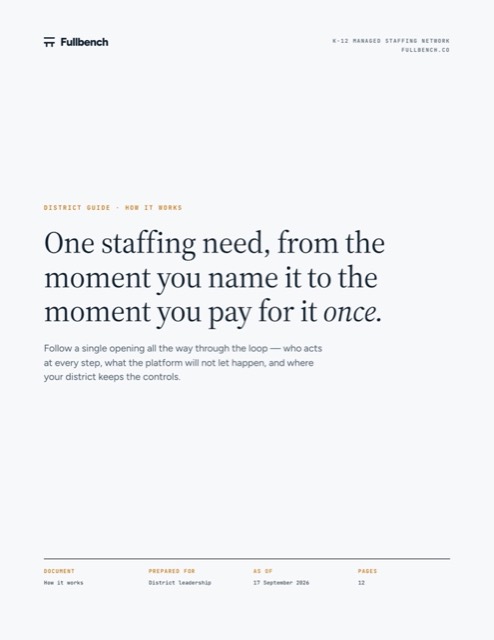
The eight steps from one posting to one invoice, drawn out: simultaneous release, the credential gate refusing a start date, and approved hours consolidating into a single bill.
Resources · Guide
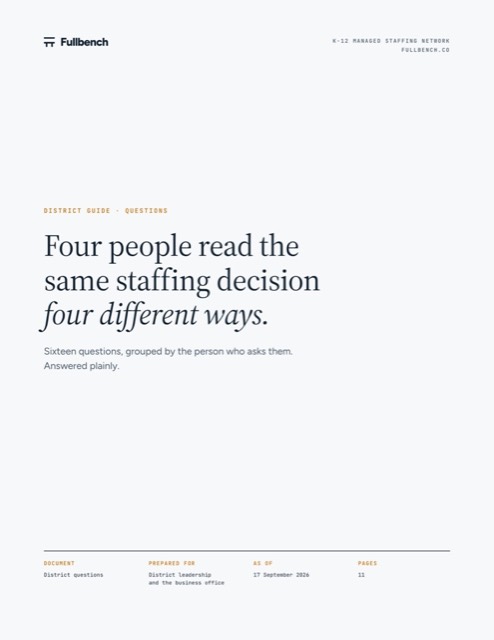
Every question a district actually asks, grouped by who asks it — the superintendent, the HR director, the business manager, the special education director.
One partner to manage every staffing agency your district uses: one contract, one invoice, one record, one contact, and no program fee to your district.
No. The agencies you trust join the program and keep working with you — your relationships stay yours. When you need more coverage, we add well-vetted suppliers alongside them.
One onboarding call. Before it, we seed your workspace with your schools, your current agencies and your common roles, so your team reviews instead of builds. On the call, we release your first real opening together.
You leave whole. Your agency relationships are direct and continue without us, and we hand you a complete export of your program record — placements, timesheets, approvals and credential statuses. There is nothing to buy out.
Your district does, at every step. Agencies submit candidates; your team reviews, interviews if you choose, and sets every status from submission through placement.
Less. A school raises a need once, to one contact, instead of contacting and following up with several agencies. Timesheets are approved on screen, and credential status is visible before a start date can exist.
Yes. The program is managed for you by default, and your team can release openings itself whenever it wants the wheel. Either way, every approved agency sees an opening at the same recorded instant.
One person: your Fullbench program contact. One call, not five — and because every release, submission, approval and status change is timestamped, "what happened here?" has a factual answer, fast.
By the participating agencies. The fee is stated in each agency's own agreement and deducted from its remittance after your district's payment is collected. The program never bills your district.
One consolidated invoice instead of a stack of agency invoices — each agency, each professional and each approved hour itemized. You pay once.
Through the program. Your schools' approved hours land on one district invoice, and when the district pays, each agency receives an itemized remittance.
Yes. Placements, timesheets, approvals and the full timestamped program record belong to your district, and you can request an export at any time.
The platform. No start date can be set while any required document is missing or still awaiting review. Your district defines the list; the platform enforces your list on every placement.
Expiry is part of the same rule. An expiry date is captured when a document is approved, an expired document stops satisfying the requirement, and a daily check emails you about your workers and the agency about its own thirty days ahead. Pulling a worker remains your decision.
No. Agencies submit; your team reviews, interviews and sets every status from submission through placement.
The record: every release, submission, approval and status change, timestamped, with who did it. You can export it whenever you ask.
| Decision | Who makes it | What the program does |
|---|---|---|
| Which agencies participate | Your district | Adds suppliers only when you ask |
| When an opening is released | Fullbench, unless your team takes it | One release, same recorded instant |
| Which candidate is hired | Your district | Records every status change |
| Which documents a role requires | Your district | Enforces your list |
| Whether a start date can be set | The gate | Holds it until every file is approved |
| Which hours are billable | Your schools | Approved timesheets are the billing record |
| Who employs the professional | The agency | Administers the program |
Take Questions Districts Ask with you
11 pages · about 8 min, formatted to print and forward to your cabinet or board.
Keep reading
Illustrated guide12 pages · about 9 min
The eight steps from one posting to one invoice, drawn out: simultaneous release, the credential gate refusing a start date, and approved hours consolidating into a single bill.
Procurement booklet11 pages · about 8 min
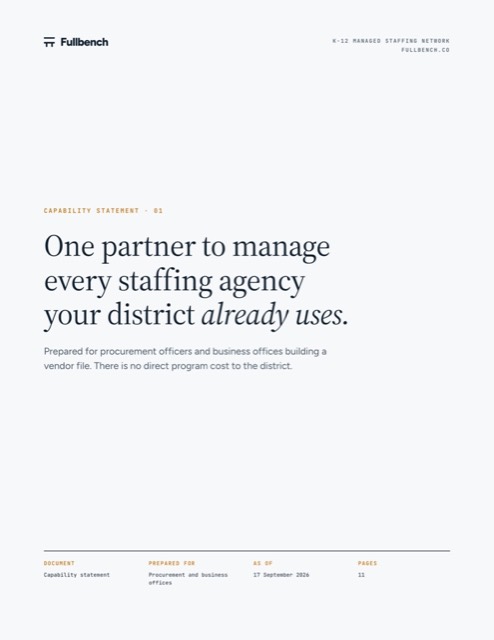
What a procurement officer needs to start a vendor file: what the program does, what it commits to in writing, and how a district adopts it without raising a purchase order.
Request a copy Sent by email
Briefing booklet17 spreads · about 10 min
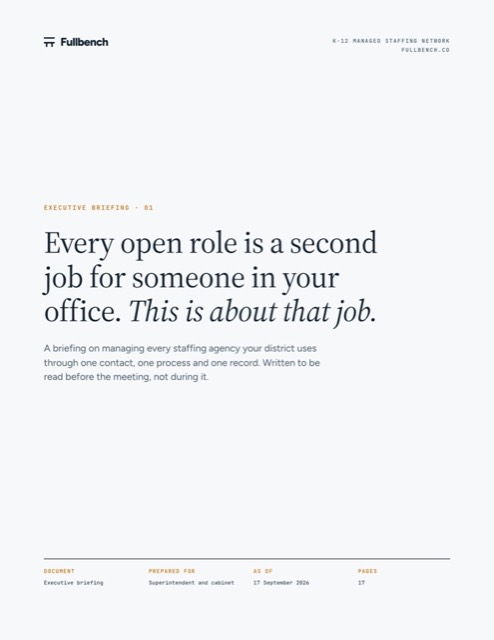
A briefing a superintendent can read alone before a meeting. One idea per spread, opening with five agencies and five invoices, closing with the first thirty days.
Next step
Fifteen minutes on your roles, your rate ceilings and the agencies you already use, with the program open. No slides, no obligation, and no cost to your district.
What we cover
You leave with a clear next step. Nothing is signed on the call.
Pick a 15-minute slot. The invite lands in your inbox before you close this.
Times show in your own timezone; we are in Eastern. If the calendar does not load on your district network, open it in a new tab or call (484) 482-8223.
A person replies the same business day, before 5pm ET, with two or three 15-minute slots. Here is the one-page version to forward to whoever else should be on the call.
Prefer to call? (484) 482-8223, weekdays 8 to 5 ET.